
Eastern Alps hiking trails offer more than mountain scenery. Across the forests and hills along the Austrian-Hungarian border, walking and cycling routes pass through landscapes shaped by Celtic settlements, Roman infrastructure, medieval castles and centuries of borderland history.
The eastern edge of the Alps provides an unusual combination for travellers who want an active weekend with a strong historical element. The lower mountain ranges stretch through Austria toward Hungary, and several trails connect natural attractions with archaeological sites, old settlements and medieval fortifications.
In Hungary, the village of Velem is one of the most interesting starting points. Deep in the Kőszeg Mountains, the white chapel of Saint Vid can be seen from a considerable distance. The chapel stands at 589 metres above sea level and was built in the early 18th century on the site of an ancient settlement.

The history of the area goes back much further. Celtic communities lived here around 2,000 years ago before the Romans arrived and established their own infrastructure. Roman forces built a watchtower in the area as part of the system protecting the aqueduct that supplied water to Savaria, the Roman settlement that developed into present-day Szombathely.
Evidence of earlier human activity is still visible in the landscape. Among the forest paths are man-made terraces associated with the Celtic settlement, giving hikers an opportunity to see traces of the area’s ancient past without leaving the mountain environment.
Velem also provides access to Geschriebenstein, the highest point in the surrounding region, which lies directly on the Hungarian-Austrian border. The route from the Hungarian side can be more demanding, while the approach from Austria is comparatively straightforward.
Another option in the Kőszeg Mountains is the Springs Trail, known locally as Források útja. The 14-kilometre route passes 11 stations and introduces walkers to both well-known and less familiar springs in the mountains. It offers a different way to experience the landscape, with water sources forming part of the route’s historical and natural character.
A few kilometres away, the Hungarian town of Kőszeg adds another important chapter to the region’s past. The small border town is known for its historic centre and Jurisics Castle, a medieval Gothic fortress closely associated with the Siege of Kőszeg in 1532.
During the siege, the castle’s captain, Nikola Jurišic, commanded a small defending force of about 50 soldiers, supported by roughly 700 local Hungarians. They faced an Ottoman army advancing toward Vienna. The defenders managed to hold the town, although the precise reasons for the Ottoman withdrawal have remained the subject of historical discussion. Heavy August rainfall is among the explanations that have been suggested.
For hikers, Kőszeg and Velem can be combined into a longer day outdoors. The route between the two passes through the mountain landscape, with cold-water springs, the Saint Vid chapel and old Styrian houses once used by foresters in the 19th century. The journey turns what could be a simple mountain walk into a way of moving through several layers of local history.
Across the border in Austria, the landscape around Lockenhaus offers a different experience. The town’s medieval castle sits within the Geschriebenstein Nature Park, surrounded by forests and a network of mountain bike routes ranging from relatively easy trails to much more demanding terrain.
Cyclists can reach the area from nearby Rechnitz, where the Burgenland Trails shuttle service operates on weekends and public holidays and is equipped to transport bicycles. From the Geschriebenstein area, riders can continue toward Lockenhaus, Rechnitz’s Badesee or across the border into Hungary.

The cycling routes are separated from the main walking paths, making the area suitable for both cyclists and hikers without forcing them onto the same trails. The main historical landmark is the 13th-century Lockenhaus Castle, whose setting in the forest adds to the sense that the landscape has changed little over the centuries.
The castle is also home to a notable colony of Geoffroy’s bats, which visitors can observe from April to July. Kestrels and swifts are among the other bird species associated with the castle, while the lake near the fortress can occasionally offer sightings of beavers.

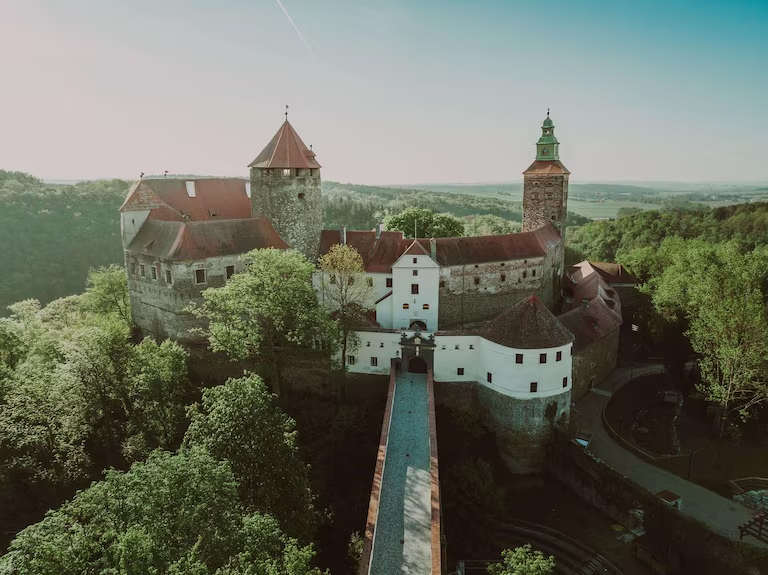
Further north, Stadtschlaining provides another glimpse of medieval Austria. Its 13th-century Burg Schlaining stands close to the Hungarian border and is about 22 kilometres from Lockenhaus along the R1 Jubiläumsradweg cycling route.
The town has retained much of its medieval character and sits among the rolling countryside of southern Burgenland. Walking and cycling are natural ways to explore the surrounding landscape, while the castle gardens provide a quieter place to finish a visit.
Stadtschlaining is also a starting point for trips into the wine-growing areas of Südburgenland. The regional wine route leads through vineyards, farms and traditional Heuriger wine taverns, where locally produced wine forms part of the area’s rural culture. Some farms also produce cider, adding another local element to a route that combines history, cycling and food.
Taken together, these routes show why the eastern Alps are worth exploring beyond the better-known mountain destinations. Around Velem, Kőszeg, Lockenhaus and Stadtschlaining, forests and hills become part of a much longer historical story, linking Celtic settlement, Roman engineering, medieval warfare and modern outdoor recreation.
For travellers who prefer to walk or cycle through a landscape rather than simply visit individual monuments, the Austrian-Hungarian border region offers a particularly rewarding way to experience the past.


