
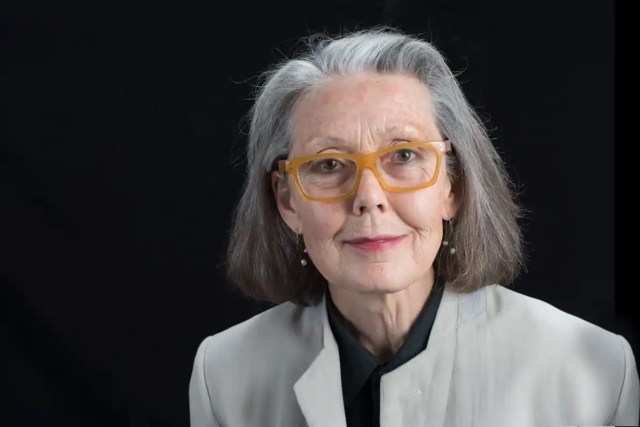
Anne Carson has won the 2026 Nobel Prize in Literature, becoming the latest writer to receive one of the world’s most prestigious literary awards for a body of work that has consistently crossed the boundaries between poetry, prose, translation and classical scholarship.
The Swedish Academy announced the Canadian poet, essayist and translator as this year’s laureate on Thursday, October 8, praising her “bold and inventive oeuvre” and saying that her playful engagement with classical traditions has created new forms for contemporary literature.

Carson, 76, has built a literary career that is difficult to place within a single genre. Her writing frequently moves between ancient Greek literature and modern life, bringing together poetry, prose, drama, translation and criticism. The result is work that often challenges conventional ideas about what a poem, essay or novel should look like.
The Swedish Academy highlighted Carson’s long-standing interest in language, particularly the relationship between the history of words and the search for new meaning. Her background as a classicist has been central to that approach, with ancient Greek literature providing material that she repeatedly reshapes for contemporary readers.
Among her best-known books is “Eros the Bittersweet”, published in 1986, which examines desire through the lens of ancient Greek literature. Her 1998 work “Autobiography of Red: A Novel in Verse” became one of her most widely recognized books. The novel in verse reimagines the Greek myth of Heracles through the story of Geryon, giving the ancient character a distinctly modern and queer coming-of-age story.
Carson continued to blur literary boundaries in “The Beauty of the Husband: A Fictional Essay in 29 Tangos”, published in 2001, and “Norma Jeane Baker of Troy”, a 2019 work that brings together the stories of Marilyn Monroe and Helen of Troy. Her most recent book, “Wrong Norma”, was published in 2024.
Her work has also included translations of classical Greek texts, plays, opera-related writing and other experimental forms. That range has made Carson an unusual figure in contemporary literature, with her work often described as genre-defying rather than fitting neatly into the categories of poetry, fiction or academic writing.
Carson was among the writers frequently discussed as a possible Nobel laureate before Thursday’s announcement. When the Swedish Academy contacted her with the news, she was in Iceland. Academy permanent secretary Ingrid Carlberg said Carson was surprised by the decision and happy to receive the award.
The Nobel Prize is also a significant moment for Canadian literature. Carson becomes the second Canadian writer to receive the Nobel Prize in Literature since the award was first presented, following Alice Munro, who won in 2013.
Carson is also the 19th woman to win the Nobel Prize in Literature. Recent female laureates include South Korean author Han Kang, who received the award in 2024, French writer Annie Ernaux in 2022 and American poet Louise Gluck in 2020.
The Literature Prize has now been awarded 119 times to 123 laureates, reflecting the occasions when the award has been shared. Last year’s prize went to Hungarian author Laszlo Krasznahorkai, who was recognized for a body of work that the Swedish Academy said reaffirmed the power of art amid apocalyptic terror.
The 2026 Literature Prize is the fourth Nobel award to be announced this year, following the prizes in physiology or medicine, physics and chemistry. The Nobel Peace Prize is scheduled to be announced on Friday, while the Sveriges Riksbank Prize in Economic Sciences in Memory of Alfred Nobel will follow on Monday.
Each Nobel Prize in 2026 carries an award of 12 million Swedish kronor, along with a gold medal and diploma. The formal Nobel Prize ceremonies will take place on December 10, the anniversary of Alfred Nobel’s death in 1896.
For Carson, the award recognizes a career built around refusing easy literary categories. Her writing has repeatedly brought ancient texts into conversation with modern questions while testing the limits of poetry, fiction, scholarship and translation. The Nobel Committee’s decision places that distinctive approach at the center of the world’s attention.


