Winter in Northern Europe changes everyday life long before the temperature becomes the main story. The most noticeable adjustment is often light: in the far north, daylight can disappear for weeks, while even southern parts of countries such as Finland experience very short winter days. In Finland, for example, the shortest day in the south is about six hours, while the northernmost part of the country experiences a period when the sun does not rise above the horizon at all.

That difference in light affects the rhythm of an ordinary day. People leave home for work or school in darkness, move through much of the day under a low winter sky and may return home after sunset. The experience is not confined to remote Arctic settlements. Helsinki, Stockholm, Oslo and other northern cities also spend a substantial part of winter with limited daylight, although conditions vary considerably by latitude, coast and altitude.
The important point is that winter in Northern Europe is not simply a season people endure until spring. It becomes part of how daily life is organised. Clothing changes. Commuting takes more planning. Outdoor activities move into different hours. Homes become more important social spaces. Streets, buildings and public areas are designed and used differently. Even something as ordinary as going to the supermarket can require a little more thought when snow, ice and darkness are part of the routine.
Finland offers a particularly clear example because of the country’s considerable north-south variation. The Finnish Meteorological Institute describes winter as the longest season in the country, lasting roughly 100 days in the southwest and around 200 days in Lapland. In northern Finland, permanent snow can cover the ground for much of the year, while conditions in the south can be considerably more variable.
That variation matters because there is no single Northern European winter experience. A person living in Helsinki is not living through the same winter as someone in Rovaniemi, Tromso or Kiruna. Coastal areas can see periods of wet, windy weather and fluctuating temperatures, while inland and northern areas can remain deeply frozen for much longer. In some places, snow is a defining feature of the season. In others, winter can alternate between snow, rain, ice and bare pavement.
For residents, the practical response begins at the front door.
Winter clothing is not an occasional accessory in the north. It becomes part of the daily system. A proper coat, insulated shoes, gloves and layers can determine whether a short walk feels routine or miserable. Footwear becomes particularly important when pavements freeze. People learn to watch surfaces as much as the weather forecast, because a seemingly ordinary journey can become hazardous when snow melts and refreezes.
Getting dressed can also take longer. There may be several layers to put on, wet clothing to dry and shoes that need to be left somewhere appropriate after coming indoors. Families with young children face an even more complicated routine, particularly when winter clothing, outdoor play and school schedules have to fit together.
Yet the cold does not necessarily mean people stop going outside.
In Nordic countries, winter outdoor life remains an ordinary part of the season. Skiing, skating, walking and other cold-weather activities are not limited to tourists looking for a dramatic Arctic experience. Finnish tourism authorities, for example, describe winter activities ranging from skiing and snowshoeing to ice skating and other outdoor pursuits, while sauna remains a familiar way of warming up afterwards.

The difference is partly cultural, but it is also practical. When winter lasts for months, waiting indoors for perfect weather would mean giving up a significant part of the year. People adapt instead. Children continue to play outside. Adults walk, exercise and commute. Parks and trails do not necessarily become empty simply because the temperature has fallen below freezing.
Darkness, however, presents a different challenge.
Cold can be measured with a thermometer. Darkness changes how time feels.
In Finland, winter cloud cover is also significant. The Finnish Meteorological Institute says autumn and winter have particularly high cloud cover, with roughly 65 to 85 percent of the sky covered by cloud on average. That means the winter experience is not simply a matter of short daylight followed by clear, star-filled nights. Many days can be grey, overcast and dim.
For someone arriving from a country closer to the equator, this can be one of the hardest parts to understand before experiencing it. The issue is not that the sun disappears completely everywhere. It is that the useful daylight available for ordinary life becomes limited, and in the far north the change is much more dramatic.
People respond in different ways. Some become more deliberate about using the daylight hours. Others rely on exercise, social activities, bright indoor spaces or simply maintaining familiar routines. Homes become places where lighting matters. Lamps are switched on earlier, curtains are opened when daylight is available and warm indoor environments become particularly valuable.
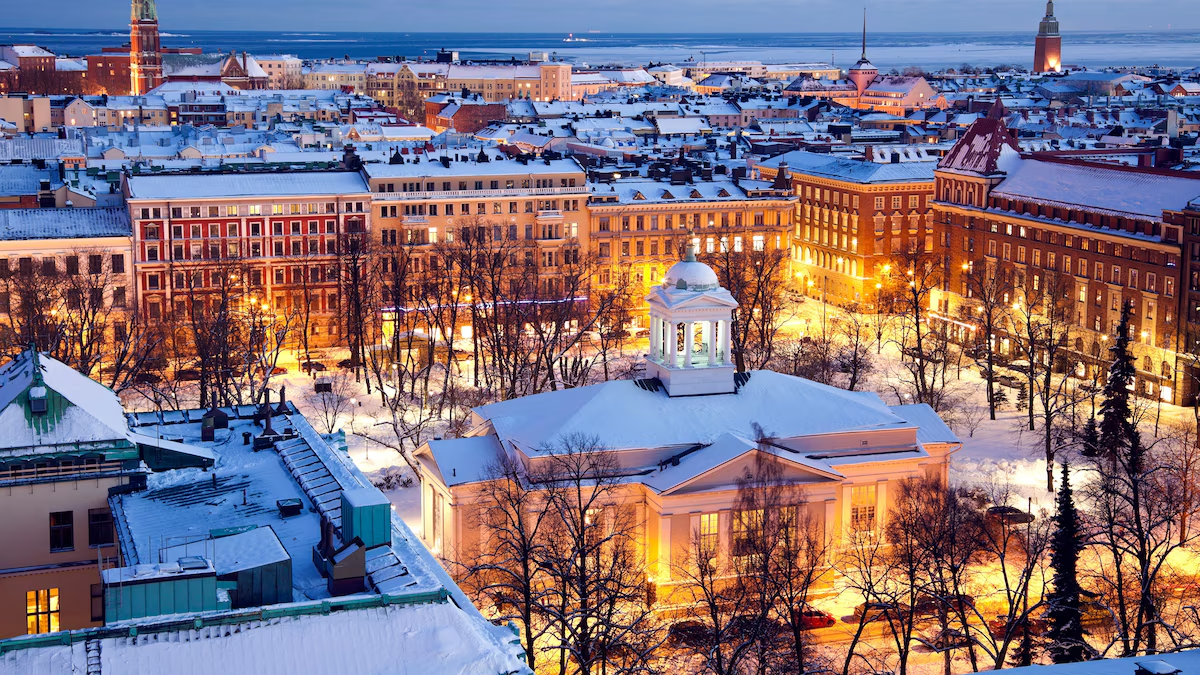
This is one reason the idea of Nordic winter is often described through words such as “cosiness”, although the reality is more complicated than a lifestyle aesthetic. Candles, warm drinks, saunas and comfortable interiors can certainly make winter pleasant, but they do not eliminate the practical demands of darkness, cold and snow.
Transport is another area where winter changes the ordinary.
A journey that takes little thought in summer can require more preparation in January. Walking speeds change on icy surfaces. Cycling may require different equipment or routes. Drivers have to contend with snow and freezing conditions. Public transport systems have to operate through weather that can affect roads, tracks and schedules.
The effect is especially visible after heavy snowfall. Snow has to be cleared, pedestrian routes maintained and vehicles prepared for conditions that can change rapidly. In Finland, snow depth is measured routinely by the national weather observation system, reflecting how central snow conditions are to winter monitoring.
Winter also changes the way people think about time outdoors. A summer evening can invite an unplanned walk, outdoor meal or trip to the lake. In winter, the same decision may depend on clothing, visibility, temperature and the condition of the route. Spontaneity does not disappear, but it becomes more calculated.
For families, school and childcare routines continue despite the weather. Nordic countries have systems designed around ordinary life in northern conditions, including school transport arrangements in cases where distances or safety make walking impractical. In Finland, for example, pupils in basic education can be entitled to free school transport when the journey is more than five kilometres or when other specified conditions apply.
The winter economy is shaped by these conditions too. Some industries depend heavily on snow and cold, from skiing and winter tourism to equipment rental and seasonal hospitality. Northern Finland, for instance, has built a substantial winter tourism identity around snow, the Northern Lights and cold-weather experiences.
But winter is not equally beneficial to everyone. Someone working outdoors faces a different reality from a visitor staying in a heated hotel. A parent managing several children through icy mornings experiences winter differently from a skier looking forward to fresh snow. Someone commuting by car may be more concerned about road conditions, while a pedestrian may think first about slippery pavements.
There is also a psychological dimension that should not be reduced to stereotypes about people in the north being naturally better at coping with darkness. Adaptation is learned, supported by infrastructure, routines and social expectations. People know what clothing works. They know how to read weather warnings. They understand when a road is likely to be icy and when snow is likely to make travel slower. Children grow up learning many of these habits as part of ordinary life.
The relationship with winter can also change as the season progresses. Early winter may feel difficult because daylight is disappearing and temperatures are falling. Later, snow can transform the landscape by reflecting available light. By March, the combination of snow and increasingly longer days can make winter feel completely different from the dark weeks of December and January. In Finland, snow cover is typically at its deepest around March in much of the country, while daylight is already increasing noticeably.
This changing relationship with light is one of the defining features of life in the north. Summer brings the opposite extreme. North of the Arctic Circle, Finland experiences periods when the sun does not set, while even southern Finland has exceptionally long summer days. The contrast between the seasons is so pronounced that the rhythm of public life changes with it.
That contrast may be the most useful way to understand Northern European winter. It is not simply about living in cold weather. It is about living through a dramatic seasonal shift in light, temperature, landscape and daily habits.
Climate change is also making the traditional picture of winter less predictable. Finland has experienced winters that are considerably milder than historical averages, and recent observations have included periods of unusually limited snow in parts of the country. The Finnish Meteorological Institute has documented substantial variation from one winter to another, including exceptionally mild periods and rapid changes in ice conditions.
That unpredictability matters because many systems have historically been built around the expectation of winter. When snow arrives late, melts early or alternates repeatedly with rain and freezing temperatures, the challenge is not necessarily less winter but a more unstable one. Roads, outdoor recreation, tourism businesses and everyday routines all have to respond to conditions that are harder to predict.
For outsiders, Northern European winter can look dramatic from a distance. Snow-covered forests, frozen lakes, illuminated streets and long dark evenings make compelling photographs. But for the people who live there, winter is much less theatrical. It is the school run, the morning commute, the wet boots left by the door, the early sunset, the supermarket trip in darkness and the decision about whether the pavement is safe enough to walk on.
It is also a season of adaptation. People learn to plan around the weather without allowing the weather to dictate everything. They continue working, studying, meeting friends, exercising and travelling. They simply do many of those things differently.
That may be the most revealing thing winter does to everyday life in Northern Europe. It does not stop ordinary life. It changes the conditions under which ordinary life happens, and over time those conditions become part of the routine.