Finland has received its first F-35 fighter jets at Rovaniemi, formally beginning the country’s transition from its ageing F/A-18 Hornet fleet to the F-35A Lightning II. The arrival marks the start of a major change for the Finnish Air Force, with the new aircraft expected to become fully operational during the first years of the next decade.
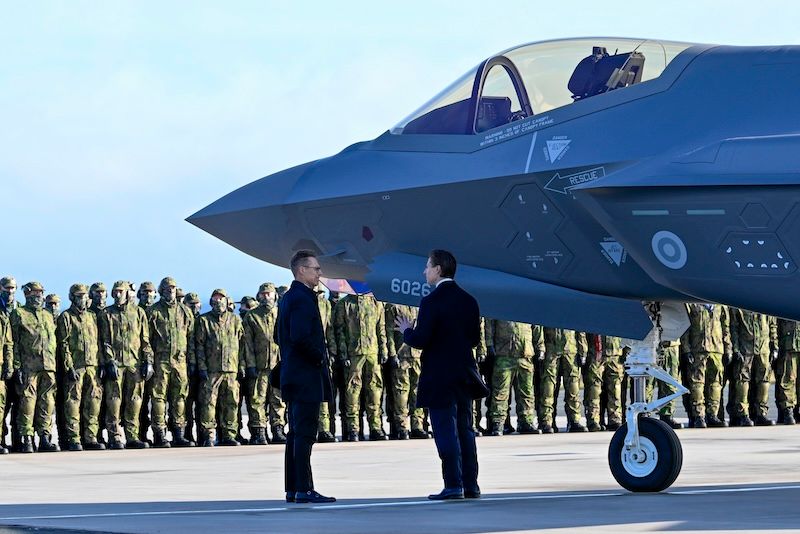
The Finnish Air Force presented the new aircraft at Lapland Air Wing in Rovaniemi on Thursday, October 1, following the arrival of the first two Finnish F-35s on September 18. An F-35 and a Hornet later took part in demonstration flights. Low cloud initially threatened to prevent the flying display, but conditions improved during the ceremony and the aircraft were able to take to the air.
President Alexander Stubb described the arrival as the start of a new period for Finland’s air force and defence. He said the F-35 programme would strengthen Finland’s defence and deterrence for decades and connected the purchase to the country’s defence relationship with the United States and its membership of NATO.
Stubb also pointed to Finland’s relationship with its eastern neighbour, Russia, while discussing the role of the new aircraft in protecting Finnish airspace. He said Finland was a predictable and safe neighbour and referred to the F-35 programme as one of the country’s key defence decisions.
Finland selected the F-35A Lightning II in December 2021 to replace the capabilities provided by its Hornet fleet. The procurement covers 64 aircraft, along with weapons, training, maintenance and other systems. The overall fighter programme has a funding allocation of about 10 billion euros, making it the country’s largest defence procurement.
The change is not simply a matter of replacing one aircraft with another. Finnish defence authorities have described the F-35 as part of a wider system that combines aircraft, sensors, communications, air defence and other military capabilities. The aircraft is designed to collect and share information and operate as part of a broader network rather than functioning only as a conventional fighter.
Defence Minister Antti Häkkänen said the F-35 programme would affect Finland’s wider defence system as the aircraft are integrated with other capabilities. Finland is also developing a new long-range air defence capability based on Israel’s David’s Sling system. Finnish government material has described the F-35 and David’s Sling as parts of a broader development of the country’s air defence during the latter part of the decade.
The first two Finnish aircraft arrived in September after being flown from the United States. A third aircraft experienced a technical problem in the Azores and was temporarily delayed before continuing preparations for its journey to Finland. Eight other Finnish F-35s remain in the United States, where Finnish personnel are undergoing training before the aircraft are introduced into domestic operations.
Rovaniemi is the first Finnish air base to begin operating the F-35. The Air Force is working toward initial operational capability there at the beginning of 2028. Karelia Air Wing at Rissala is scheduled to receive its first F-35 aircraft during 2028, while deliveries are expected to continue until 2030. The Finnish government has previously described the transition from initial operational capability to full operational capability as a three-year process beginning in 2028.
The transition has also required major changes at Finnish air bases. Shelters, maintenance facilities, training areas, storage and other infrastructure have been built or adapted to support the new aircraft. The work is part of a wider effort to ensure that the F-35 can operate from Finland rather than simply being delivered as a standalone weapons system.
For Finland, the programme also has an important economic and strategic dimension because the aircraft are closely tied to a US-led international support and development system. Stubb acknowledged questions about Finland’s dependence on American technology and argued that the relationship should be viewed as one of mutual dependence, pointing to cooperation between the two countries in defence, technology, minerals and icebreakers.
The scale of the investment has also attracted attention because the F-35 is entering Finnish service while the wider international programme continues to face technical, maintenance and modernisation challenges.
One of the major issues concerns the aircraft’s planned Block 4 modernisation. The upgrade is intended to add new capabilities, but parts of the programme have been delayed. Finnish F-35s were ordered in the Block 4 configuration, while some of the capabilities associated with the broader modernisation effort are still being developed. Finnish reporting has put the expected timing for some of these upgrades into the 2030s.
The US Government Accountability Office reported in June that F-35 readiness had deteriorated across the US fleet. Its figures showed the mission-capable rate falling from 67 percent in fiscal year 2021 to 44 percent in fiscal year 2025. The full mission-capable rate, which measures whether aircraft can perform all of their assigned missions, fell from 38 percent to 25 percent over the same period.
The problems identified by the GAO include shortages of spare parts, maintenance capacity and other sustainment difficulties. The F-35 Joint Program Office has responded with a new sustainment strategy that calls for an additional estimated $13.7 billion through fiscal year 2031, with the aim of improving fleet readiness.
The scale of the global fleet has added to the pressure. During testimony to a US Senate subcommittee in June, F-35 Joint Program Office director Lieutenant General Gregory Masiello said the sustainment system had effectively been built for roughly 700 to 800 aircraft while more than 1,300 F-35s were operational. The testimony highlighted the difficulty of expanding maintenance and spare-parts support at the same pace as the international fleet.
These international programme issues do not change the immediate task facing Finland. The Finnish Air Force now has to train its personnel, establish the necessary infrastructure and bring the aircraft into operational service while continuing to operate the Hornet fleet during the transition.
For Finland, the next stage will therefore be less about the ceremony in Rovaniemi and more about turning the new aircraft into a functioning part of the country’s defence system. The first F-35s have arrived, but the replacement of the Hornet fleet will continue for several years before Finland reaches the full capability planned for the new fighter force.