Middle East policy: SDP will seek a vote of no confidence in Prime Minister Petteri Orpo’s government, saying disagreements within the governing coalition have created an unclear position on Finland’s foreign and security policy, particularly over Israel and the Palestinian territories.
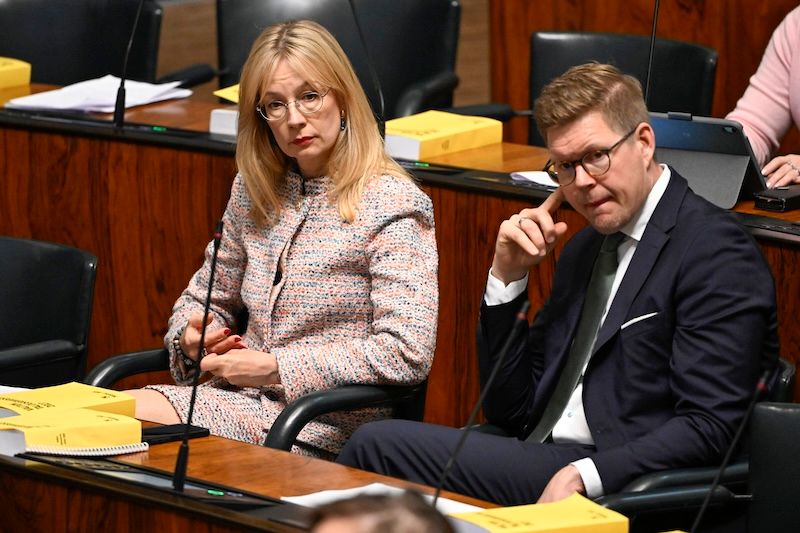
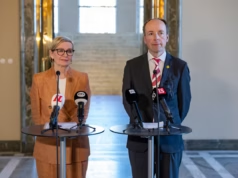
SDP chair Antti Lindtman, parliamentary group chair Tytti Tuppurainen and Foreign Affairs Committee chair Johannes Koskinen announced the move on 27 September. The three argued that ministers and governing parties have sent different messages on Finland’s approach to the Middle East and said the government has failed to present a consistent policy. These are the opposition party’s political assessments, rather than an established finding about the government’s conduct.
One of the main disputes concerns Finland’s position on Israeli settlements in the occupied West Bank. In early September, Foreign Minister Elina Valtonen of the National Coalition Party said Finland had joined an international statement supporting trade restrictions on products originating from Israeli settlements considered illegal under international law. The statement was backed by Finland and other countries.
The announcement was followed by criticism from within the governing coalition. Christian Democratic Party chair Sari Essayah and Finns Party parliamentary group chair Jani Makela criticised Valtonen’s decision, arguing that she had acted without sufficient coordination. The disagreement exposed different views within the coalition over how Finland should respond to Israeli settlement activity.
Foreign Trade and Development Minister Ville Tavio of the Finns Party later said Finland was not preparing trade restrictions on settlement products and that he would not support such measures at EU level. The SDP has used the conflicting statements from government ministers as one of the main reasons for its no-confidence initiative.
The opposition has also criticised Tavio’s decision to end Finnish funding for the UN agency for Palestinian refugees, UNRWA. The SDP argues that the agency plays an important humanitarian role in the region. Tavio’s decision is part of the wider disagreement between the opposition and government parties over Finland’s policy towards the Palestinian territories.
Another issue raised by the SDP is Defence Minister Antti Hakkane n’s visit to Israel and his meeting with Israeli Defence Minister Israel Katz. The opposition has questioned how the visit fitted into Finland’s wider foreign and security policy and whether issues concerning international law were raised during the meeting.
Hakkane n has rejected the suggestion that the visit was intended as a separate political message. In parliamentary discussion, he defended meeting his Israeli counterpart as part of normal diplomatic and defence relations. The government has therefore disputed the SDP’s interpretation that the visit demonstrated a lack of coordination.
The question of recognising a Palestinian state has added another layer to the dispute. President Alexander Stubb has said he would be ready to recognise Palestine if the government formally brought the matter forward. The government has not taken that step, and the SDP has pointed to the difference between the president’s position and the government’s approach.
The SDP says these differences have damaged Finland’s credibility abroad and created uncertainty about the country’s foreign and security policy. Koskinen has argued that the government needs a clearer and more coordinated position, while Tuppurainen has similarly said the issue is whether Finland is speaking with one voice on Middle East policy.
The governing parties have rejected the opposition’s criticism. National Coalition MPs have accused the SDP of using foreign and security policy as a domestic political issue. Prime Minister Orpo has also criticised the opposition’s approach to the government’s policy, showing that the dispute is now part of a wider political confrontation between the government and opposition.
The no-confidence motion will be considered by Parliament in plenary session. Under Finland’s parliamentary system, the government or an individual minister can be subjected to a confidence vote in Parliament. The upcoming vote will therefore provide a formal parliamentary test of whether the government’s coalition parties continue to support its handling of the issue.
For the government, the immediate question is whether its parties can maintain a common position despite their differences over settlements, humanitarian assistance, relations with Israel and recognition of Palestine. For the SDP, the vote is an opportunity to challenge what it describes as a lack of consistency in the government’s foreign policy. The parliamentary debate will put those competing positions on the record.