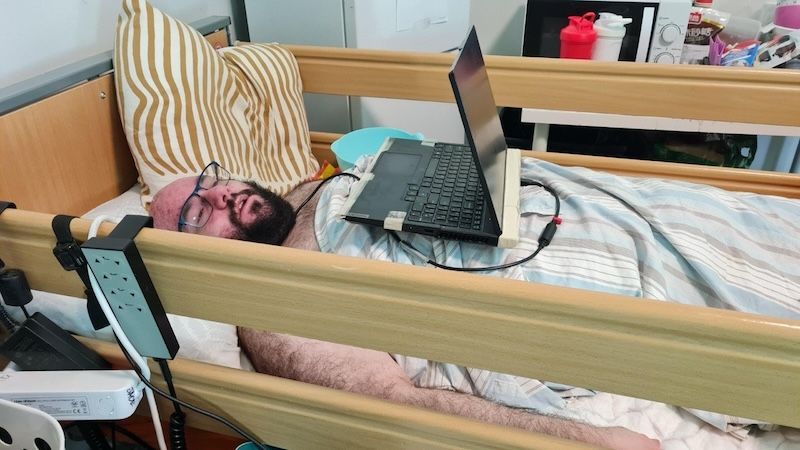
Finland removes terminally ill man Jace Eon Ilias to the US while his family-based residence appeal was still pending in court.
Jace Eon Ilias, a 32-year-old American citizen with terminal Huntington’s disease, was removed from Finland in September and flown to the United States by private medical aircraft while his appeal against a family-based residence permit decision was still being considered by a Finnish court.
Ilias had been living in a care home in Tuusula, where he required round-the-clock assistance and was no longer able to move or care for himself independently. He was taken from the facility by ambulance early on a Tuesday morning and transported to Helsinki-Vantaa Airport, where a Jetflite air ambulance was waiting to take him across the Atlantic. Finnish authorities arranged the removal after concluding that he could be considered a threat to public order and security.
The case has drawn criticism from human rights advocates and raised questions about how Finland handles the removal of people with serious and terminal illnesses, particularly when their immigration proceedings have not fully ended.
Ilias arrived in Finland in 2023 and applied for asylum, citing discrimination and vulnerability as a member of a sexual and gender minority in the United States. The Finnish Immigration Service, Migri, rejected his asylum application. His final appeal was dismissed by the Supreme Administrative Court in March 2025.
His circumstances changed significantly during the immigration process. Ilias married his Finnish partner, Lehto Itkonen, in January 2025 and later applied for a residence permit on the basis of family ties. That application was also rejected.
The couple argued that their circumstances were exceptional, including Ilias’s serious illness and the couple’s health situation. Migri’s decision referred to an incident at Helsinki-Vantaa Airport in November 2024 and concluded that there was reason to believe Ilias could threaten public order and security.
The circumstances surrounding that incident remain disputed. Finnish authorities described Ilias’s behaviour at the airport as aggressive and threatening. His relatives and supporters have said his behaviour was connected to his illness, fear and previous traumatic experiences.
A related criminal investigation concerning the airport incident remains unresolved. There has been no court judgment establishing that Ilias committed a crime. Migri has also stated that a suspicion of this nature could not by itself have been sufficient to reject a residence permit based on family ties. The authority said the case required an overall assessment.
The legal terminology surrounding the case is also important. The procedure was a refusal of entry and removal, known in Finnish as “kaannyttaminen”, rather than the deportation procedure known as “karkottaminen”. The distinction matters because the two procedures are based on different provisions of Finnish immigration law.
Despite the pending appeal concerning his family-based residence permit, the authorities proceeded with the removal in September. Ilias was transported from the care home to Helsinki-Vantaa and then placed on a chartered medical flight to the United States.
The operation involved significant resources. According to the Helsinki Police, the cost was at least EUR 100,000, with the private charter flight accounting for most of the expense. The final cost was still being calculated and could also include preparation and allowances connected with the operation.
The aircraft carried two Finnish nurses, a doctor, a representative of the Non-Discrimination Ombudsman and several officials from the police and Border Guard. The flight was scheduled to arrive at Teterboro Airport in New Jersey, where the Finnish authorities handed Ilias over to the US side.
He was later taken by ambulance to a hospital in Queens, New York.
The transfer has also raised questions about what happened to Ilias after he arrived in the United States. According to reporting by Yle, his spouse and people supporting the family were initially unable to establish where he had been taken. A support network contacted hospitals in New Jersey and New York before locating him in Queens.
Yle also reported that Ilias was subsequently diagnosed with COVID-19 and that there were concerns about his access to his regular medication after the transfer. Finnish police said medical documents, a medication list and a referral concerning his continued care had been provided to the US ambulance personnel in English. The account from people involved in Ilias’s care differed, with concerns raised about whether the information needed by his doctors had reached them in sufficient detail.
The Finnish authorities have maintained that their responsibility was to carry out the removal and hand the person over to the authorities of the receiving country.
Chief Inspector Jarmo Heinonen of the Helsinki Police said the police could not know exactly what happened after the handover. He said the role of the police was to organise the return and ensure that the person was transferred to the authorities of the other country.
The case has put particular attention on Huntington’s disease, an incurable and progressive neurological disorder that affects movement, cognition and behaviour. The disease can cause involuntary movements, difficulties with communication and changes in mood and behaviour. Symptoms can include irritability and aggression, although their severity varies between individuals.
Those symptoms are relevant to the dispute over what happened at Helsinki-Vantaa Airport. Ilias’s relatives have argued that behaviour interpreted by officials as a threat may have been connected to the effects of his illness and the circumstances in which he was being detained and prepared for removal.
That does not establish what happened during the airport incident. The available accounts remain different, and the underlying allegations have not been determined by a court.
The case therefore raises a broader question about how immigration authorities assess risk when a person’s medical condition can itself affect behaviour. It also raises questions about how much weight should be given to a person’s current physical condition when officials make decisions based on earlier conduct.
Ilias was already bedridden by the time of his removal. His condition required continuous care, and his transfer from a Finnish care facility to another country therefore involved more than an ordinary immigration removal.
Finnish authorities arranged medical transportation rather than a standard commercial flight. Medical staff accompanied him on the aircraft, and an ambulance was arranged after his arrival in the United States.
The disagreement concerns what happened after that handover and whether the arrangements provided enough continuity of care for someone in Ilias’s condition.
His case has also attracted criticism from organisations concerned with human rights and discrimination. Amnesty International and Finland’s Non-Discrimination Ombudsman have raised concerns about how serious medical conditions should be considered in removal cases, according to recent Finnish reporting.
For Ilias’s husband, the removal also meant the sudden separation of a married couple who had been living together in Finland. Itkonen remained in Finland while Ilias was taken to the United States.
The couple’s immigration history had already involved several unsuccessful applications. Ilias’s asylum application was rejected even though Migri acknowledged that conditions for sexual and gender minorities in the United States had become more difficult. The authority nevertheless considered the United States a functioning state governed by the rule of law and found that this did not prevent his return.
The later residence permit application based on the marriage was assessed separately. The airport incident and the authorities’ assessment of the potential threat to public order became part of that decision.
The timing of the removal has become one of the central issues in the case. Ilias’s family-based residence permit appeal was still before the courts when the removal was carried out. His supporters have questioned why the authorities did not wait for the judicial process to finish.
Finnish immigration authorities, however, proceeded under the powers available to them and treated the removal decision as enforceable.
The case has also prompted comparisons with immigration enforcement in other countries, particularly the United States. Such comparisons can obscure an important difference: Finland’s system includes administrative decision-making, judicial appeals and oversight mechanisms, and an official from the Non-Discrimination Ombudsman was present during Ilias’s removal.
At the same time, the existence of those procedures does not settle the questions raised by this particular case. The central issue is whether the legal and administrative safeguards were sufficient when the person being removed was terminally ill, required continuous care and still had a pending appeal concerning his right to remain in Finland.
The Finnish government and immigration authorities now face questions about how medical vulnerability is assessed in removal decisions and what obligations apply when a person requires intensive care after being returned to another country.
There is also a practical question about responsibility. Once a person has been handed over to the authorities or medical services of another country, Finnish officials have limited control over what happens next. But in a case involving a severely ill patient, the adequacy of the arrangements made before that handover becomes an important part of the decision to remove the person in the first place.
Ilias’s case has brought those questions into public view because the circumstances are unusually severe. He was not being moved from one ordinary residence to another. He was a terminally ill, bedridden patient being transported across the Atlantic under the supervision of Finnish authorities and medical personnel.
Recent Finnish reporting has confirmed that he was eventually located in a Queens hospital, where he has continued to receive treatment. His case has since become the subject of public discussion and demonstrations in Finland, with supporters demanding greater transparency over the decision and the circumstances of his removal.
The legal proceedings and the unresolved dispute over the airport incident mean that important questions remain unanswered. What exactly happened at Helsinki-Vantaa? How did officials assess the connection between Ilias’s medical condition and his behaviour? Why was the removal carried out while the family-based residence case was still under judicial consideration? And what arrangements were considered sufficient to ensure continuity of care after his arrival in the United States?
Those questions are now part of a wider debate in Finland about immigration enforcement, medical vulnerability and the limits of state responsibility when a person facing removal is also seriously ill.
For Ilias and his husband, however, the issue is more immediate. They are now separated by the Atlantic, while Ilias continues to receive treatment in New York after being removed from the country where he had been living and receiving care.