Finland’s bid for a seat on the UN Security Council for 2029-2030 took centre stage as President Alexander Stubb used his address to the United Nations General Assembly in New York to call for renewed international cooperation, stronger respect for international law and major changes to the way the Security Council operates.
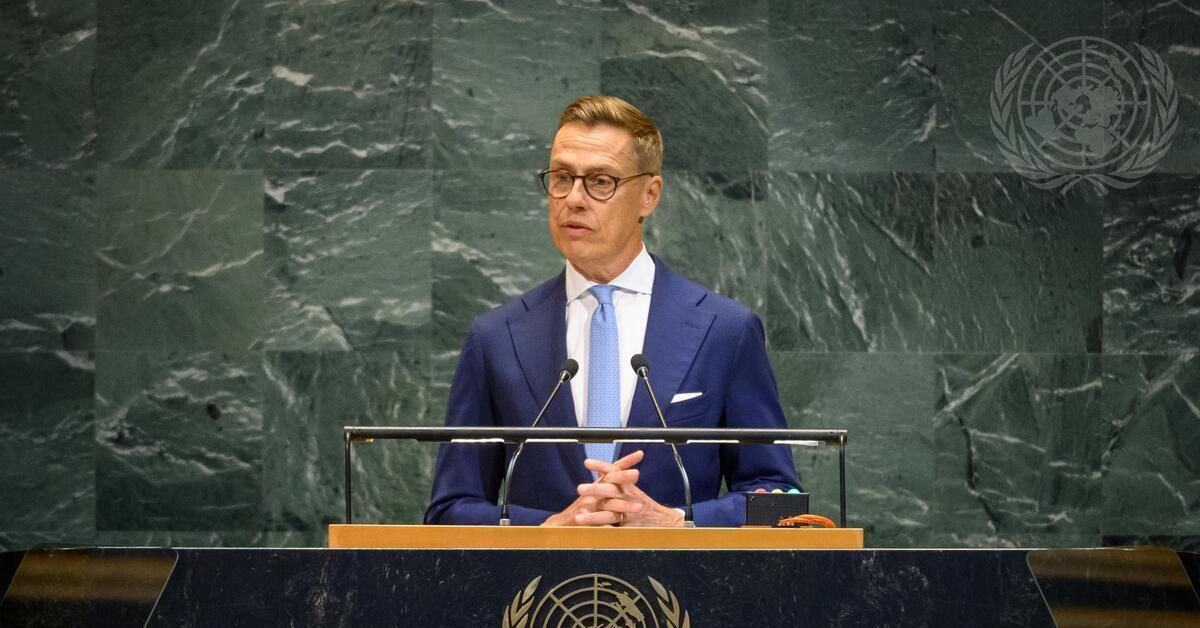
Speaking on Tuesday, September 22, Stubb presented the international system as facing a basic choice between cooperation and conflict. He argued that growing distrust between countries, disregard for international rules and weakening institutions were making it harder to manage disputes before they turn into wider conflicts.
“Foreign policy is based on a choice between co-operation or conflict,” Stubb told world leaders, making cooperation the central theme of his speech.
The Finnish president acknowledged that competition between states is unavoidable, particularly as countries adjust to a changing balance of power. His concern, he said, is that governments are increasingly willing to compete outside the rules that have governed international relations for decades.
Stubb’s answer was not to reject competition but to strengthen the framework around it. He called for countries to uphold international law, respect humanitarian principles and use language that reduces rather than deepens political divisions. In his view, rules are not an obstacle to national interests but part of what prevents competition from escalating into conflict.
The speech came during a UN General Assembly marked by wars, diplomatic tensions and questions about whether existing international institutions can respond effectively to a rapidly changing world. The 81st session has also placed artificial intelligence, the future of multilateral cooperation and reform of the UN system high on the agenda.
For Finland, however, the gathering carries another significance. Helsinki is campaigning for a non-permanent seat on the Security Council for the 2029-2030 term. Finland’s candidacy is part of a broader effort to strengthen its role in the UN and international diplomacy. The election will take place in 2028.
Stubb used his address to repeat Finland’s proposals for reforming the Security Council, arguing that its current structure no longer reflects the international balance of power. He called for at least two additional permanent seats for Africa, two for Asia-Pacific and one for Latin America. He also proposed removing the veto power of individual states and suspending the voting rights of Security Council members that violate the UN Charter.
The proposals reflect an argument Finland has been making for several years: that an institution created in the aftermath of the Second World War cannot remain unchanged while the political and economic balance of the world has shifted. Stubb raised similar concerns in his 2025 General Assembly address, when he argued that the UN’s decision-making structures still largely reflected the realities of 1945.
He also called for a stronger role for the UN in peace mediation. Stubb argued that regional organisations and smaller coalitions of countries can help address conflicts and shared challenges when agreement among all UN members is difficult, but said such groups should reinforce the UN rather than replace it.
He pointed to the Coalition of the Willing for Ukraine as one example of countries working together around a specific conflict. Stubb said these flexible forms of cooperation could become increasingly important as countries seek new partnerships in response to geopolitical uncertainty.
The war in Ukraine remained a central issue at the General Assembly. Stubb described Russia’s invasion as unlawful and said the search for peace must remain consistent with the UN Charter. UN Secretary-General Antonio Guterres also described Russia’s invasion as a violation of the Charter during his final General Assembly address before leaving office at the end of 2026.
The Middle East dominated much of the wider debate. Guterres warned about the humanitarian situation in Gaza and the erosion of prospects for a two-state solution, while other leaders used the General Assembly to condemn or defend actions taken during the conflict. US President Donald Trump, meanwhile, warned Iran that the United States could take further military action if an agreement was not reached, while also suggesting that diplomacy remained possible.
Stubb also raised Gaza, Sudan and Haiti in his speech, describing the situation in Gaza as one of the world’s most serious humanitarian crises. He pointed to displacement, destruction of infrastructure and limited access to basic services, and called for greater resources for conflict prevention and human rights.
Artificial intelligence was another significant part of the Finnish president’s message. Stubb described AI as a technology with consequences for science, the economy, politics, security and society. Finland and Norway have joined an international call for governments, companies, regional organisations and the UN to develop mechanisms for controlling frontier AI models, and Stubb urged more UN member states to support the initiative.
His wider argument was that international cooperation has to adapt rather than disappear. Countries may form regional partnerships or temporary coalitions around particular issues, but Stubb said these arrangements should remain connected to a broader multilateral system.
Finland’s Security Council campaign therefore comes at a moment when the UN itself is under pressure to demonstrate that it can still bring countries together. Stubb’s proposed “new San Francisco moment” was a reference to the 1945 conference where governments negotiated the UN Charter. He argued that the next UN secretary-general should lead a process in which countries renew their commitment to the principles on which the organisation was founded.
For Finland, the message is closely tied to its Security Council campaign. Stubb said Finland wants to take on the responsibilities of Council membership at a time when the international system needs greater commitment to peace, dialogue and cooperation. The country has framed its candidacy around peace, people and partnerships.
Stubb ended his speech by returning to a line from former UN Secretary-General Kofi Annan: “Whatever our differences, we stand or fall together.” It captured the central argument of Finland’s message in New York: that international institutions may need reform, but cooperation remains the mechanism through which countries can manage their differences without allowing competition to become conflict.