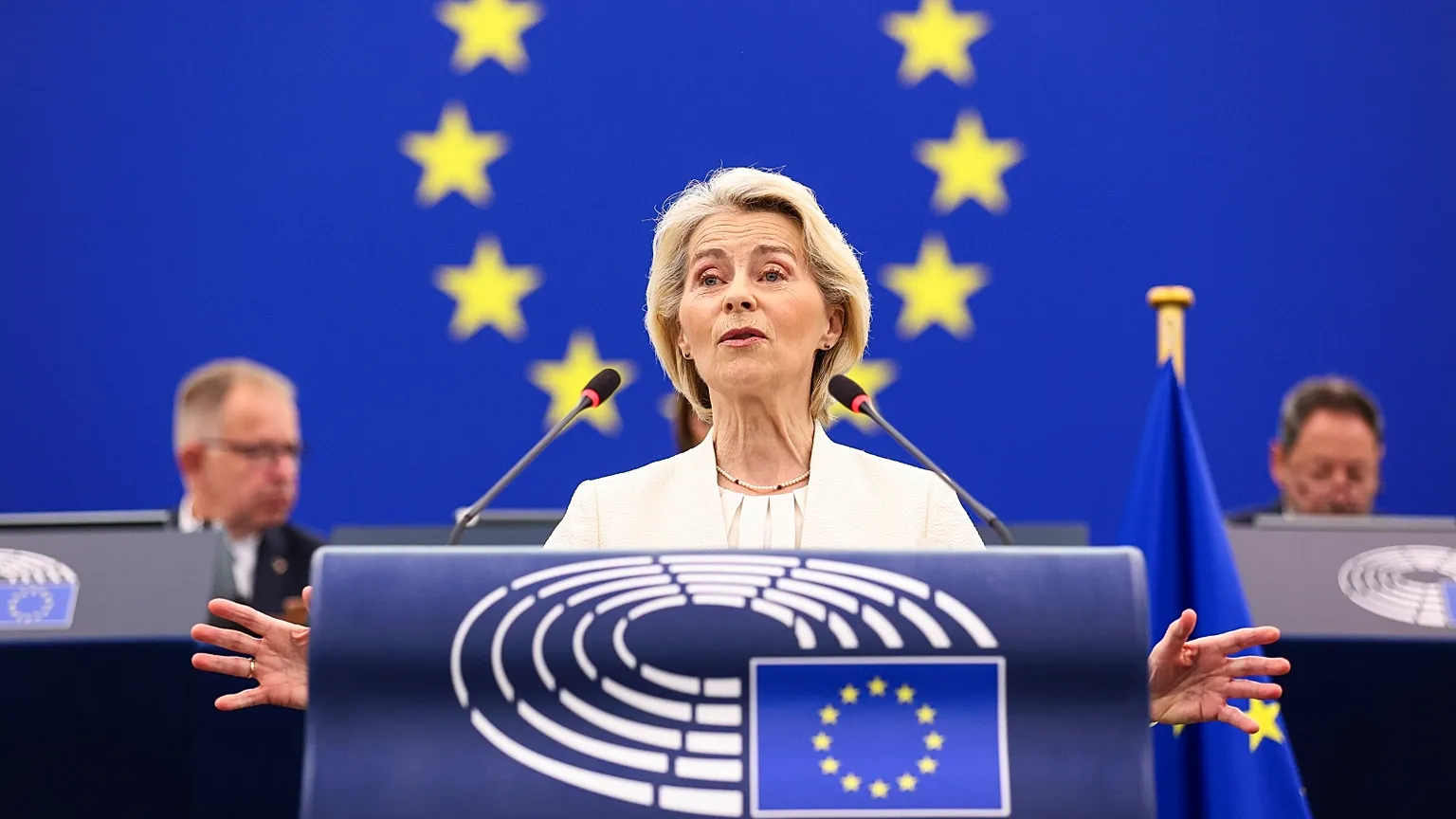
EU plans social media restrictions for children under 15 moved closer to the political agenda this week after European Commission President Ursula von der Leyen announced plans for new age-based rules covering children’s access to online platforms.
Under the proposal, children under 13 would be prohibited from using social media, while 13 and 14-year-olds would only be able to use accounts created and supervised by a parent or guardian. Those accounts would come with limited functions and daily time restrictions.
The proposed rules would also introduce additional safety requirements for teenagers aged 15 to 17. Online platforms would face greater responsibility for demonstrating that their services protect younger users, including safeguards against harmful content and features designed to encourage people to remain online for longer periods.
Von der Leyen made the announcement during her State of the Union address to the European Parliament in Strasbourg on Wednesday. She said young Europeans currently spend between four and six hours a day in front of screens and argued that some digital platforms are designed to keep children engaged for extended periods.
The European Commission plans to develop the measures through a proposed Kids Act. The initiative follows recommendations published in July by a Commission-appointed panel examining child safety online. The panel had called for age-based approaches to access to social media and other online services.
The proposal is part of a broader effort by Brussels to place greater responsibility on technology companies for the safety of children and teenagers using their platforms. Rather than leaving parents to manage the risks alone, the Commission wants platforms to demonstrate that their products and design choices provide appropriate protection for minors.
The debate is already taking shape in Finland. National recommendations published in January advise against personal smartphones and social media use for children under 13. The Finnish government is also preparing a report examining possible restrictions on social media use for children under 15.
The Finnish position means that the proposed EU approach would not be entirely new to parents and policymakers in the country. The difference would be that EU-level legislation could establish common rules across member states rather than relying primarily on national recommendations and policies.
The Commission’s plans extend beyond children’s social media use. Von der Leyen also used the speech to outline a broader security and technology agenda for the European Union, including a proposed European Security Council involving EU leaders and partners such as Britain, Canada, Norway and Ukraine.
She proposed an emergency security mechanism modelled on NATO’s Article 4 that could be used to coordinate responses to threats including cyberattacks, sabotage and drone incidents that fall below the threshold of armed conflict.
Canada was also given a new role in the Commission president’s vision for European cooperation. With Canadian Prime Minister Mark Carney attending the address in Strasbourg, von der Leyen proposed that Canada work with the EU towards becoming the bloc’s first “associate member”. The arrangement would provide deeper cooperation without giving Canada full EU membership.
Artificial intelligence was another major theme of the address. Von der Leyen called for Europe to increase its computing capacity and expand the use of AI across areas including healthcare, manufacturing, agriculture, transport and defence. She also said the Commission would engage developers of advanced AI systems on questions surrounding safety and the speed at which the technology is being developed.
Finland received a specific mention in that part of the speech. Von der Leyen highlighted Finnish entrepreneur Pekka Laurila and Polish entrepreneur Rafal Modrzewski, the founders of satellite imaging company ICEYE, as an example of European technological entrepreneurship. The two met through the Erasmus programme and were applauded by members of the European Parliament.
The State of the Union address also covered Ukraine, migration, climate adaptation, trade relations with China and the EU’s relationship with Israel. The annual speech is used by the Commission president to review developments from the previous year and outline the European Commission’s priorities for the year ahead.
For parents and young people, however, the proposed social media rules could become one of the most directly felt parts of the Commission’s agenda. If the Kids Act results in binding EU rules, access to social media for younger teenagers would no longer be governed solely by individual platforms, parents or national recommendations. The details, including how age would be verified and how parental supervision would work in practice, will be important as the proposal develops.
At this stage, the announcement represents a proposed policy direction rather than a completed EU-wide ban. The Commission still has to set out the measures in detail and take them through the EU’s legislative process before any new rules could become binding.