Canada associate membership in the European Union is now being discussed at the highest level after European Commission President Ursula von der Leyen said she wants to open the door for Canada to become the bloc’s first associate member.
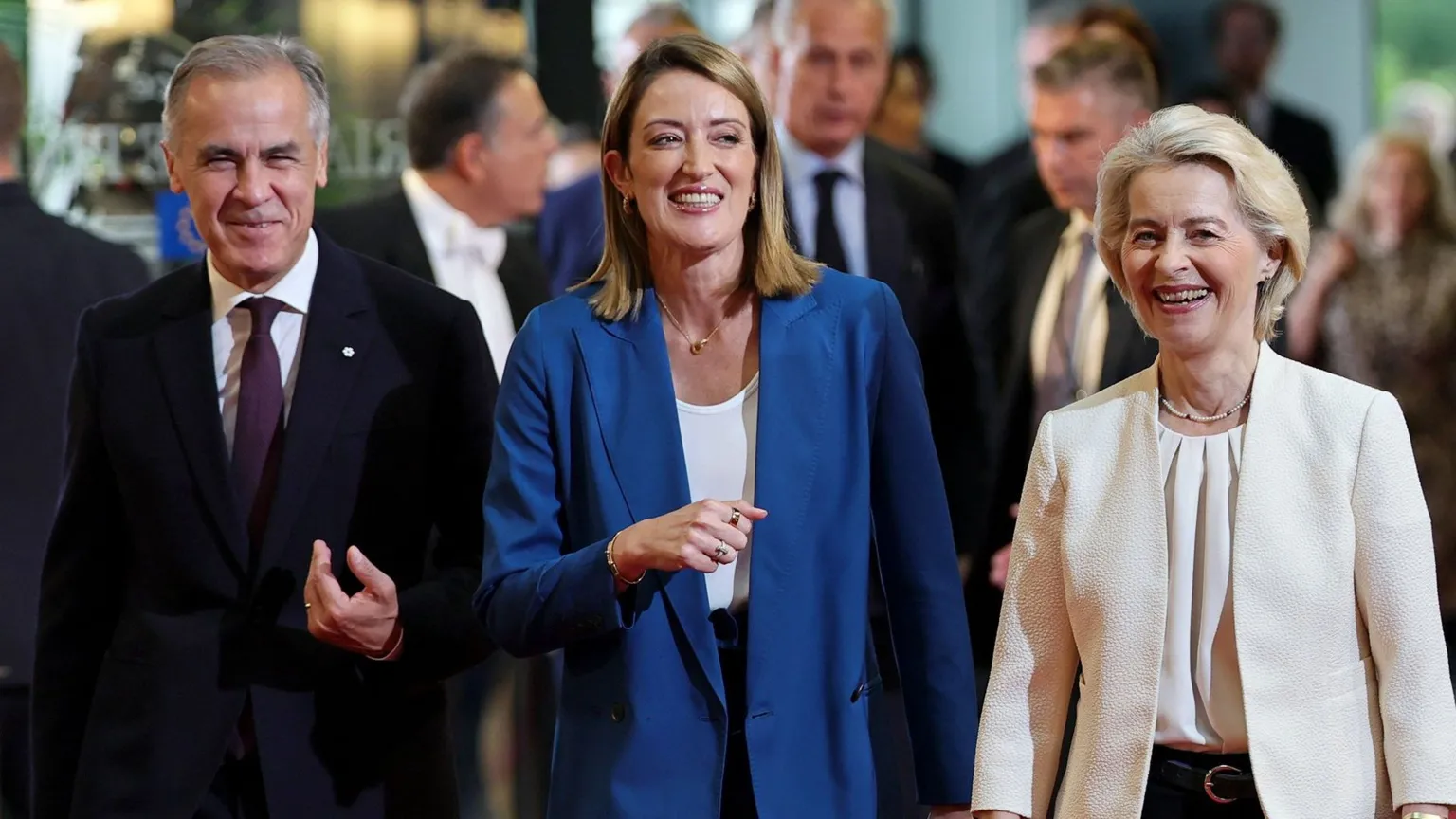
She made the proposal on Wednesday during her annual State of the European Union address in Strasbourg, with Canadian Prime Minister Mark Carney in the European Parliament.
The idea would create a new type of relationship between Canada and the EU, allowing much closer cooperation without making Canada a full EU member. Von der Leyen did not explain exactly what the proposed status would involve, and associate membership is not currently part of the EU’s existing treaties. Any such arrangement would therefore require further negotiations and agreement among EU countries.
Von der Leyen presented the proposal as part of a broader effort to build stronger partnerships outside the traditional EU framework. She said Europe and Canada already share similar positions on areas including artificial intelligence, climate change, the Arctic, Ukraine, defence, raw materials and supply chains. She also pointed to democracy as a central part of the relationship.
The proposed partnership could cover manufacturing, technology, defence, energy, critical minerals, batteries, artificial intelligence, quantum technology, cybersecurity and economic security. Von der Leyen said the EU wanted to move beyond the existing Canada-EU trade relationship and build what she described as an “Alliance for the Future”.
Carney has also been pushing for a closer relationship with Europe. He has described Canada’s goal as a “unique alliance” with the EU as Ottawa looks to strengthen its international partnerships. The timing is important because Canada is dealing with serious trade tensions with the United States, including new tariff measures and repeated comments from US President Donald Trump about Canada becoming the 51st US state.
Von der Leyen did not describe the proposed Canadian relationship as an alliance aimed at the United States. Instead, she said partnerships were a strategic choice for Europe and argued that closer cooperation with Canada would strengthen both sides.
The EU and Canada already have a major trade agreement known as CETA, which has been provisionally applied since 2017. Von der Leyen said trade in goods between the EU and Canada has increased by 75 percent in less than a decade. However, not all EU member states have completed the process needed to fully ratify the agreement.
The proposed associate membership would therefore go well beyond trade. It could create a closer framework for cooperation in areas that are becoming increasingly important to both sides, particularly defence, energy, technology and access to critical minerals.
There is no guarantee that the idea will quickly become reality. Creating an associate membership system would raise legal and political questions inside the EU, including what rights Canada would receive and how much access it would have to EU institutions, programmes or markets. The bloc would also have to agree on the structure of any new arrangement.
The idea is not entirely new. Germany’s Chancellor Friedrich Merz has previously suggested that Ukraine could eventually receive some form of associate EU membership. But the concept has not yet become an established category within the European Union. Countries such as Albania, Bosnia and Herzegovina, Montenegro, North Macedonia and Serbia are instead pursuing the existing route towards full EU membership, while Georgia and Moldova are also seeking membership.
Canada’s case would be different because it is geographically outside Europe and is not seeking full EU membership. The proposal would therefore test whether the EU can create a new model for close cooperation with countries that share many of its political and economic interests but do not fit the traditional enlargement process.
Von der Leyen also used her speech to propose a European Security Council involving countries and partners beyond the EU. She said such a body could include the United Kingdom, Ukraine, Canada and Norway, reflecting growing calls for a wider European security framework following Russia’s full-scale invasion of Ukraine in 2022.
For now, Canada associate membership remains a proposal rather than an agreed EU policy. There is no existing legal status for it, no defined timetable and no detailed agreement between Ottawa and Brussels. What has changed is that the European Commission president has publicly placed the idea on the political agenda, signalling that the EU is considering a much closer relationship with Canada at a time when both sides are reassessing their international partnerships.