European city tourism continued to grow in 2025, with 107 of 141 cities recording an increase in overnight stays, according to the latest City Travel Report from CityDNA.
The 22nd edition of the report covers a record 141 European cities and found that total bednights increased by an average of 4.1%. That was slower than the 5.8% growth recorded in 2024, but the overall picture remained positive.
The report points to a wider change in how European cities are approaching tourism. Rather than focusing only on attracting more visitors, destinations are increasingly looking at the economic value of tourism, its effect on residents, pressure on local infrastructure and its environmental cost.
Barbara Jamison-Woods, President of City Destinations Alliance, said European destinations were entering a more mature period of tourism growth. She said the focus was moving beyond visitor numbers towards the value created for communities, businesses, travellers and the environment.
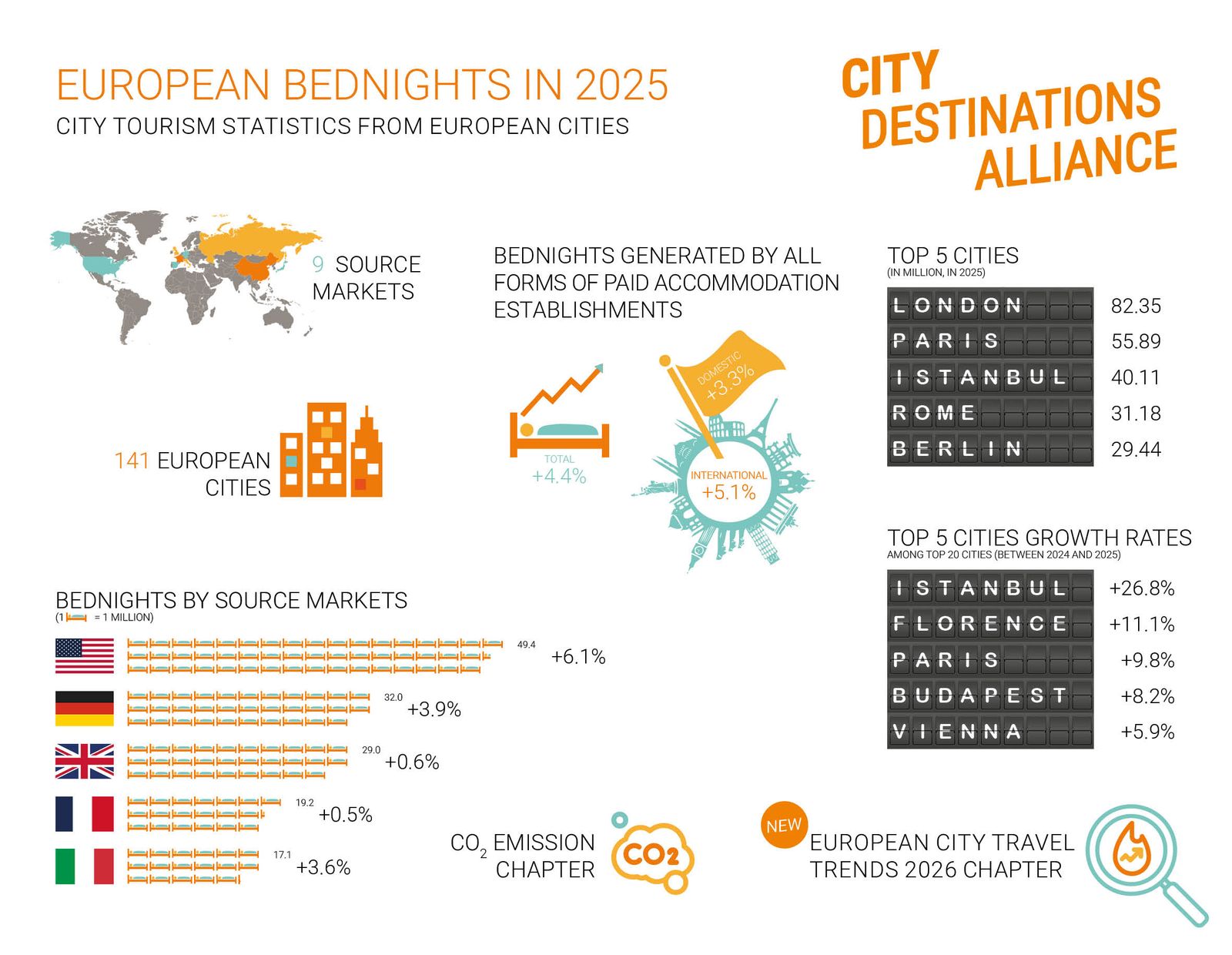
London remained Europe’s largest city destination in 2025, recording 82.35 million bednights. Paris followed with 55.89 million, while Istanbul moved into third place with 40.11 million.
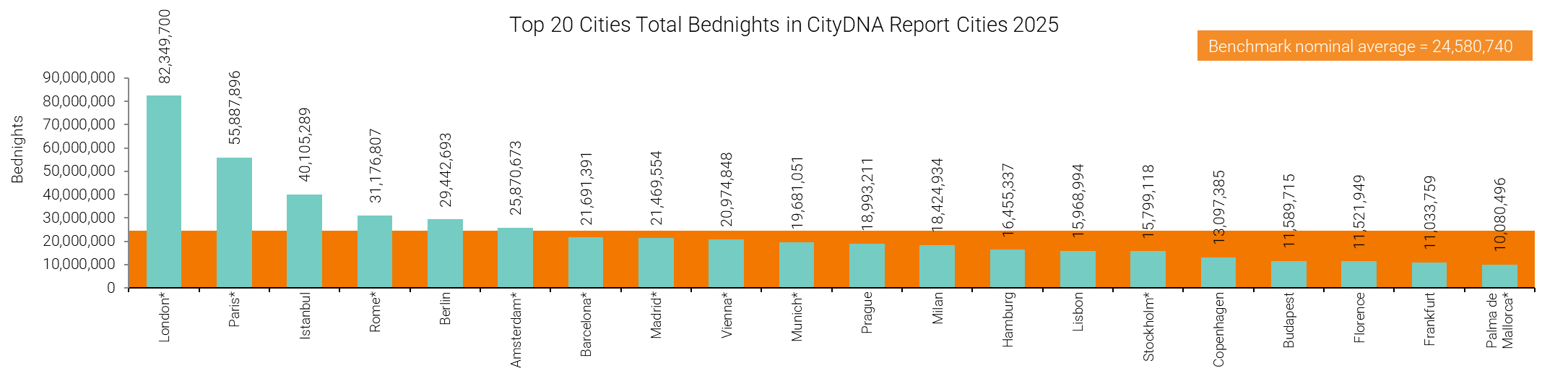
Istanbul also recorded the strongest growth among the 20 largest city destinations, with bednights increasing by 26.8%. Florence recorded 11.1% growth, while Paris increased by 9.8%.
The figures also show a stronger return of long-haul visitors to European cities. All nine main source markets included in the report recorded growth in 2025.
The United States remained the largest source market, generating 49.4 million bednights, an increase of 6.1%. Germany followed with 32 million bednights and 3.9% growth, while the United Kingdom recorded 29 million bednights, up 0.6%.
Japan showed the strongest growth among the main markets, with bednights increasing by 12.3%. China followed with 9.8% growth. The United States also grew faster than several of Europe’s closer source markets.
The report says the slower overall growth rate should not automatically be viewed as a sign of weaker tourism. International bednights in CityDNA cities increased by 5.1%, compared with 14.3% across the EU27 and the United Kingdom. However, CityDNA cities recorded stronger overall bednight growth than other areas, increasing by 4.4% compared with 1.4%.
One reason for the slower growth in some cities is that destinations are facing limits on how much tourism they can accommodate. Concerns about residents’ quality of life, available capacity and environmental pressure are also influencing tourism policies.
Prof. Karl Wöber, President of Modul University Vienna and Scientific Partner of the report, said more moderate growth should be considered alongside factors such as local capacity, the mix of visitor markets and the priorities of individual destinations.
The report also found that accommodation capacity increased by 2.9% in 2025, while average bed occupancy fell from 48.8% to 47.5%. This suggests that accommodation supply expanded faster than demand in some cities.
Environmental results were mixed. Transport-related carbon dioxide emissions per tourist increased by only 0.2%, while 26 of the 72 cities analysed for this measure recorded a reduction in emissions.
Tourism pressure also differs greatly between destinations. Across the cities included in the report, there was an average of 92 tourist bednights for every resident. The figure varies considerably between cities, showing why tourism policies designed around a single European target may not work equally well everywhere.
The 2025-2026 report also introduces a new chapter on European City Travel Trends 2026, prepared with contributions from GetYourGuide. It examines changes in traveller behaviour, demand for experiences and opportunities for cities to connect tourism more closely with local culture.
Taken together, the figures show a European city tourism market that is still expanding, but at a more measured pace. For many destinations, the discussion is increasingly moving away from simply increasing visitor numbers and towards deciding what kind of tourism can deliver lasting benefits without placing unnecessary pressure on the cities themselves.