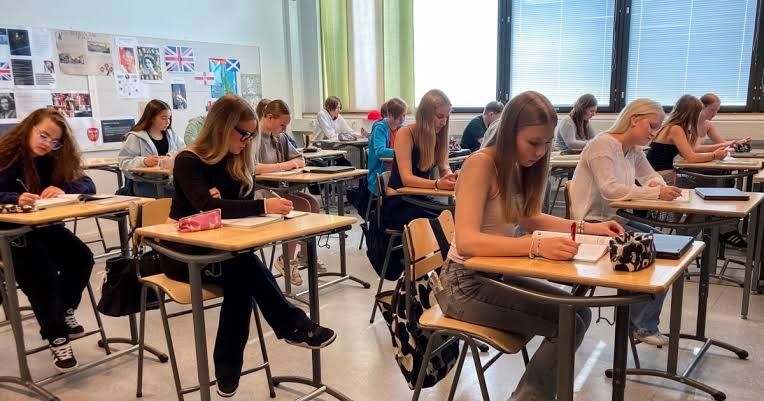
Finland’s 2026-27 school year begins with several changes that will affect how students learn, receive support, use phones, stay active and study languages.
Schools across Finland are returning at different times. Helsinki, Oulu, Jyvaeskylae, Joensuu, Lahti and Rovaniemi are among the cities where classes began on 12 August. Espoo and Vantaa start on Thursday, while pupils in Kokkola, Turku and Pori returned on Tuesday. Tampere started the school year on 6 August.
The exact starting date is decided by each municipality or education provider. Finnish law normally provides for 190 school working days, although public holidays that fall on weekdays can reduce the total. The 2026-27 school year has 189 working days, and comprehensive schools will finish on Saturday, 5 June 2027.
The new school year is not simply a return to the usual timetable. Several reforms are now affecting everyday school life.
Some changes started earlier but continue to shape the new academic year. Others came into force this month, including new rules for vocational education and additional changes affecting language teaching.
The overall direction is clear. Schools are being asked to pay more attention to students’ physical activity, learning difficulties, language needs and progress toward completing their education.
One of the most noticeable changes is the new legal duty for pre-primary and comprehensive schools to promote physical activity.
This does not mean that every school day will suddenly contain more traditional physical education lessons. The idea is broader. Schools are expected to create more opportunities for children to move during the day.
That could include being more active during breaks, adding movement to lessons or changing how school spaces are used.
The Finnish National Agency for Education points to research connecting physical activity during the school day with concentration, learning, behaviour and how pupils feel about school.
For schools, this creates a practical challenge. Finding more time for movement has to fit alongside an already demanding curriculum. The reform therefore affects how the school day is organised, not just what happens in physical education classes.
Mobile phones will continue to face restrictions in Finnish classrooms.
The restrictions introduced at the beginning of the previous school year remain in place. Students cannot simply use their phones during lessons whenever they want.
A pupil needs permission from a teacher to use a phone or another mobile device for educational purposes or for reasons connected to health.
The Finnish National Agency for Education has also recommended that schools consider restrictions during breaks and other times when students are not in lessons.
The issue is larger than whether pupils should have their phones in their pockets. Schools are trying to create learning environments where attention is not constantly divided between classroom work and notifications, messages or social media.
The rules also leave room for legitimate uses. A phone is not treated as something that can never be used at school. Its use has to have a clear reason and, in most cases, the teacher’s permission.
Finland has also been changing how students receive help when they struggle with their studies.
The learning support reform for pre-primary, comprehensive and upper secondary education began in August 2025. One important principle is that support should be provided within the student’s own teaching group whenever possible.
This represents a move away from waiting until a student’s difficulties become serious before providing help.
In practice, schools are expected to identify learning needs earlier and provide support as part of normal teaching before turning to more individual measures.
The aim is to make support easier to access and more closely connected to everyday teaching.
This matters because students do not all learn at the same speed. A child who falls behind in one subject may need targeted help without being separated from the rest of the class.
The reform also puts greater responsibility on schools and teachers to recognise problems early and respond to them.
Vocational education has now joined this wider reform. From 1 August 2026, vocational students have a legal right to learning support throughout their studies.
That support also applies to workplace learning.
This is particularly important because vocational education does not take place only inside classrooms. Students often spend part of their education in workplaces, where difficulties with learning, communication or completing tasks can affect their progress.
The goal is to help students complete their qualifications and move into employment or further education.
Language education is also changing.
Some pupils enter Finnish comprehensive schools after completing preparatory education. For these students, moving into ordinary classroom teaching can be difficult if they are still developing their Finnish or Swedish skills.
Education providers can now offer one additional year of instruction to pupils moving from preparatory education into comprehensive school.
The decision about whether a pupil studies Finnish or Swedish as a first or second language will also focus more directly on the pupil’s actual language skills.
This means the language programme will not simply be decided by the mother tongue recorded in population records.
That distinction matters in a country where many children grow up using more than one language. A pupil’s registered background does not always show how well they understand or speak Finnish or Swedish.
The new approach gives schools more room to look at the student’s real language ability when deciding what kind of teaching is appropriate.
English is also becoming more visible in Finnish upper secondary education.
Seven schools are starting English-language programmes this month. According to the Finnish National Agency for Education, 132 students have been selected for 170 available places.
The change is part of a wider development in Finnish education, where some students can complete more of their studies in English.
There is also a major examination change ahead. English-language matriculation examinations are scheduled to begin in autumn 2028.
This will give students studying through English a formal examination route that is more closely aligned with their language of instruction.
For international families and students who have built their education around English, the development could make Finland’s upper secondary system easier to navigate.
The reforms do not stop with the beginning of the 2026-27 school year.
Parliament approved legislation on a competence guarantee in June. The reform is intended to establish clearer national expectations for what students should know and be able to do as they move through school.
One part of the planned system involves national assessment procedures and criteria connected to grades 10, 8 and 5 across subjects and year groups.
The Finnish National Agency for Education is expected to revise the national curriculum framework by the end of October 2027.
Local education providers will then have to bring their curricula into line with the new national framework from August 2028.
The purpose is not simply to create another set of rules for schools. The competence guarantee is intended to establish minimum levels of knowledge and skills that students should reach as they progress through the education system.
That could make expectations more consistent between schools and municipalities. It could also make it easier to identify when a student needs additional support before gaps become harder to close.
The school year will also follow the usual Finnish pattern of breaks spread across the academic year.
Autumn holidays will mainly take place during weeks 42 and 43, depending on the municipality.
Christmas holidays in many parts of Finland will run from around 22 December until 6 January.
Winter holidays will be staggered across different parts of the country between 22 February and 12 March.
The exact dates can differ between municipalities, so families should check their local school’s calendar rather than relying on a national date.
The changes taking effect around the 2026-27 school year point to a Finnish education system that is trying to address several everyday problems at the same time.
Schools are being asked to protect learning time from unnecessary phone use, give children more opportunities to move, provide support earlier, respond more carefully to language needs and ensure students receive help throughout vocational studies.
None of these changes will transform Finnish schools overnight. Much of the work will happen quietly in classrooms, staff meetings, lesson planning and conversations between teachers and families.
The real test will be how consistently the reforms are applied.
A national rule can establish what schools should do, but municipalities and education providers still have to make it work in real classrooms with different students, teachers, facilities and resources.
For students and parents, the important point is that the 2026-27 school year is part of a larger period of change in Finnish education. Some rules are already in effect, while others are being prepared for the years ahead.
For anyone starting school in Finland this autumn, that means more than a new timetable. The way students learn, receive support, use technology and demonstrate their skills is gradually changing too.