
Most Chaotic Airports to Transit in Africa!
There is a predictable mismatch between the ambition of African aviation corridors and the physical realities of the airports that anchor them. Transit does not always behave like a controlled sequence here. It behaves more like a negotiation between passenger volume, infrastructure limits, and shifting operational priorities.
The result is not uniform across the continent. But a pattern emerges in specific hubs where connecting passengers consistently encounter compression points that reshape schedules, patience, and sometimes entire itineraries.
African aviation is expanding through a network effect rather than a single linear upgrade cycle. Major hubs absorb traffic not only from their own national carriers but also from regional redistribution and long-haul intercontinental routing.
This creates a layered system. International arrivals feed into regional departures. Regional arrivals feed into domestic networks. All of this converges in terminals that were often designed for simpler traffic patterns.
Transit stress, therefore, is rarely random. It is structural. It emerges where capacity, security design, and airline scheduling intersect unevenly.
Lagos Murtala Muhammed International Airport:

Lagos operates at a scale that consistently tests its infrastructure tolerance. Murtala Muhammed International Airport is one of West Africa’s most important aviation gateways, yet its transit environment reflects the strain of sustained passenger growth.
Queues form not just at immigration, but across multiple transition stages between arrival processing and onward boarding. Ground handling efficiency varies significantly by terminal and time window, which introduces uncertainty into short connections.
The core challenge is not visibility of congestion. It is predictability. Even experienced travelers often treat Lagos transit as a buffer-dependent process rather than a tightly timed connection.
Cairo International Airport:

Cairo International Airport functions as a continental crossroads linking Africa, the Middle East, and Europe. This positioning makes it one of the most heavily utilized transit airports in the region.
Cairo International Airport Transit Dynamics
The airport’s structure reflects incremental expansion rather than a single unified design philosophy. Multiple terminals and security stages create a system where connection efficiency depends heavily on routing clarity and passenger flow management.
For transit passengers, the experience is often defined by timing sensitivity. A minor delay in one segment can cascade into rebooking scenarios, especially for interline transfers between different airline alliances.
Nairobi Jomo Kenyatta International Airport:

Nairobi has become a primary redistribution hub for East African air traffic. Jomo Kenyatta International Airport handles a large volume of connecting passengers moving between regional capitals and long-haul destinations.
The transit experience is shaped by physical movement between zones and security reprocessing for connecting flights. During peak periods, congestion tends to concentrate around a few predictable bottlenecks.
Despite this, Nairobi reflects a broader trend in African aviation: increasing efficiency in airline scheduling paired with infrastructure that is still adapting to intensified hub status.
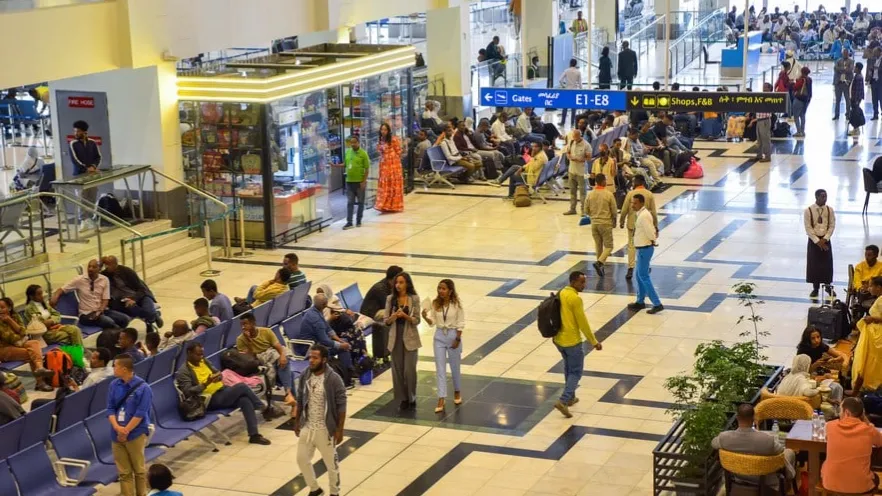
Addis Ababa Bole International Airport:

Addis Ababa Bole International Airport plays a critical role as a transfer hub for East Africa and long-haul routes into Asia and Europe. Its importance is amplified by the scale of connecting traffic routed through Ethiopian Airlines networks.
Transit flows are often efficient in sequencing but sensitive to delays. Tight scheduling windows mean that operational disruptions can have amplified effects on passenger movement.
The airport’s strength lies in connectivity density. Its challenge lies in maintaining flexibility when demand peaks converge.
Johannesburg OR Tambo International Airport:

Johannesburg OR Tambo International Airport is one of the most developed aviation hubs on the continent. Its infrastructure is comparatively modern, and its international transit systems are well established.
Yet even here, transit complexity emerges during peak hours. High passenger volumes on intercontinental routes create pressure on security rechecks and gate allocation systems.
The contrast is notable. Infrastructure quality is high, but demand intensity still produces congestion patterns that affect transfer reliability.
Kinshasa N’djili International Airport:

Kinshasa N’djili International Airport operates in a more constrained environment. Its transit challenges are closely tied to limited infrastructure redundancy and variable processing speeds.
Transfer passengers often encounter longer processing times, particularly during peak arrival waves. The system has less elasticity to absorb delays, which makes timing more sensitive compared to larger hubs.
This is where transit becomes less about connection design and more about operational endurance.
Transit Pressure in Chaotic Airports in Africa Transit
The phrase chaotic airports in Africa transit does not describe disorder in a literal sense. It describes systems under continuous pressure where small inefficiencies accumulate into visible passenger friction.
Across multiple hubs, three patterns repeat:
- Concentrated traffic flows through limited gateway airports
- Multi-layered security and transfer requirements
- Infrastructure expansion lagging behind passenger growth
These conditions do not affect all airports equally. But where they overlap, transit becomes less predictable and more dependent on buffer time and operational coordination.
The Direction of Change Across African Transit Hubs
African aviation is not static. New terminals, runway expansions, and airline network optimization are gradually reshaping how transit functions across the continent.
However, the transition period itself creates uneven experiences. Modern systems operate alongside legacy infrastructure, and that overlap defines much of the current transit reality.
The trajectory is clear. Efficiency is improving. But the system is still absorbing decades of compressed growth.