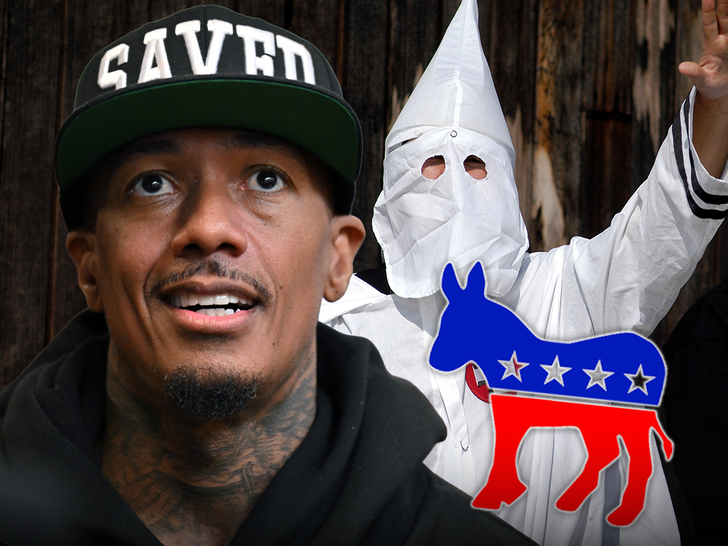
Nick Cannon Democratic Party KKK comments have reignited a familiar and often misunderstood debate about American political history, identity, and the limits of modern party loyalty.
During a recent episode of his “Big Drive” show, Nick Cannon spoke candidly in a way that felt less like a scripted media moment and more like an unfiltered reflection. Sitting alongside Amber Rose, Cannon described the Democratic Party as the “party of the KKK”, pointing to its historical association with the Ku Klux Klan during earlier periods of United States history.
The remark landed quickly and predictably. It circulated across social media platforms, drawing both support and criticism, but more importantly, it exposed how selectively historical narratives are often used in present day political arguments.
Cannon’s reference is not without historical grounding, but it exists in a context that is frequently stripped of nuance. The Democratic Party of the 19th century, particularly in the American South, did include factions that were tied to the Ku Klux Klan. That much is documented. However, political parties in the United States have undergone significant ideological realignment over time.
When Cannon mentioned Abraham Lincoln and the Republican Party’s role in ending slavery, he touched on another well established historical fact. Yet the modern Republican and Democratic parties do not map neatly onto their 19th century identities. This is where much of the confusion, and often intentional simplification, begins.
Political historians have long pointed to shifts in voter bases, regional loyalties, and policy priorities, especially during the mid 20th century civil rights era. These changes complicate any direct comparison between past and present party structures.
Cannon did not position himself as a supporter of either major party. Instead, he framed his views through the lens of independence. In doing so, he echoed sentiments similar to those expressed by W. E. B. Du Bois, who at various points in his life questioned the effectiveness and sincerity of a two party system.
This rejection of strict political alignment is not unusual in today’s media environment. Public figures increasingly distance themselves from rigid labels, choosing instead to emphasize personal belief systems over party loyalty. For Cannon, the message was less about endorsing one side and more about rejecting the framework altogether.
One of the more noticeable aspects of Cannon’s comments was his tone when referencing Donald Trump. While he did not declare support, there was a softer edge compared to earlier public criticism. This kind of shift, even when informal, tends to attract attention in a polarized political climate.
It reflects a broader trend where public figures navigate political conversations carefully, often balancing personal views with audience expectations and potential backlash.
The reaction to Cannon’s remarks reveals more about the current political environment than the statement itself. In an era where historical references are frequently used as rhetorical tools, context is often the first casualty. Conversations quickly become binary, leaving little room for deeper examination.
What Cannon’s comments ultimately highlight is a persistent gap in public understanding of political history. It is a gap shaped by selective storytelling, partisan framing, and the speed at which information moves today.
There is also a cultural layer to consider. When a figure like Nick Cannon speaks, the reaction is not just political but social. His platform brings these discussions into spaces where audiences may not typically engage with historical or political analysis, which can both broaden awareness and amplify misunderstanding.
In the end, the moment is less about one statement and more about how history is interpreted, repackaged, and deployed in modern discourse. Cannon did not present a fully developed political thesis, but his comments succeeded in reopening a conversation that remains unresolved and, at times, deliberately simplified.