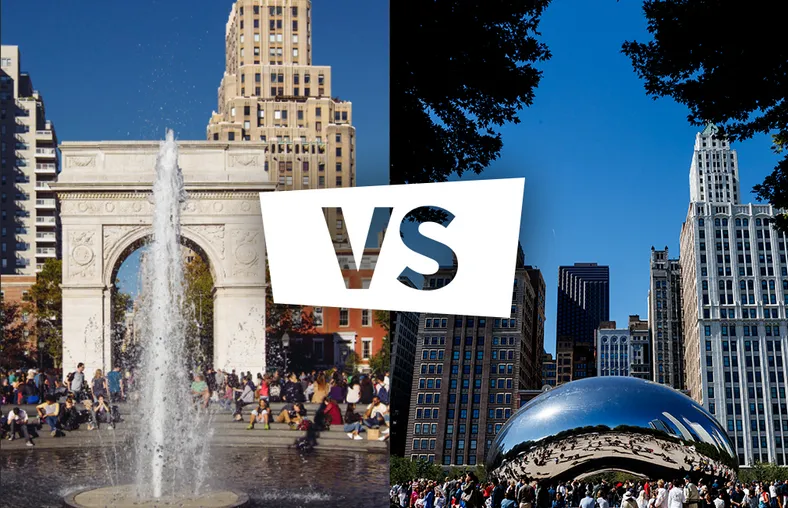
NYC vs Chicago Travel Comparison: Two Cities, Two Completely Different Travel Rhythms.
New York City rarely asks for your attention. It assumes it. Chicago, by contrast, earns it gradually. The distinction matters more than preference. It shapes how a visitor moves, spends, and ultimately remembers each place.
Both cities anchor the American urban imagination, yet they operate on different internal logics. One is compressed, global, relentless. The other is expansive, structured, and quietly self-assured. A travel decision between them is less about ranking and more about alignment with intent.
Urban form and movement
New York City compresses experience into vertical density. Neighborhoods overlap functionally and culturally. Manhattan alone delivers a near continuous sequence of landmarks, commerce, and transit nodes. The subway system runs 24 hours, which removes the concept of a last train. This creates a rhythm where time feels elastic.
Chicago is horizontal by comparison. The grid is legible. Distances are longer but more predictable. The elevated “L” system defines movement, but it does not dominate it. Walking remains practical, especially in central districts like the Loop and River North. Travel days feel more structured. You notice transitions between neighborhoods rather than sliding through them.
The implication is simple. New York rewards spontaneity and stamina. Chicago rewards planning and pacing.
Cost structure and value perception
Accommodation pricing in New York remains among the highest in the United States. Even midrange hotels in Manhattan often exceed 250 to 350 USD per night in peak seasons. Short term rentals are heavily regulated, limiting alternatives. Dining follows a similar pattern, with wide variance but a consistently high floor.
Chicago offers a more forgiving cost structure. Comparable hotel quality often lands 20 to 40 percent lower. Restaurant pricing is also more accessible, especially outside high demand districts. Portions tend to be larger, service less hurried.
This difference influences trip length. Visitors often compress New York into shorter, more intense stays. Chicago supports longer visits without the same financial pressure.
Cultural density and institutions
New York’s cultural infrastructure is unmatched in scale. Institutions like the Metropolitan Museum of Art, Broadway theaters, and a constant rotation of global exhibitions create a sense of cultural saturation. The city functions as a global stage. You are rarely the only visitor encountering something for the first time.
Chicago’s cultural scene is more contained but deeply rooted. The Art Institute of Chicago, the architecture along the Chicago River, and a strong tradition of music and comedy create a cohesive identity. The experience feels less crowded, more local, and often more reflective.
New York offers breadth. Chicago offers coherence.
Food systems and dining culture
New York’s dining landscape is defined by global representation. You can map migration patterns through its restaurants. High end dining coexists with street level food in tight proximity. Reservations often require planning days in advance, especially in trend driven establishments.
Chicago’s food culture is shaped by regional identity and immigrant influence, but it expresses itself with less urgency. Deep dish pizza and Chicago style hot dogs remain symbolic, yet the broader scene includes serious fine dining and a strong neighborhood restaurant culture. You are more likely to find availability without compromising quality.
The practical difference is friction. Eating in New York often requires strategy. In Chicago, it requires curiosity.
Architecture and visual experience
New York’s skyline is iconic but fragmented. Each borough contributes to a layered visual identity. The city’s architecture tells a story of constant reinvention, often without pause for symmetry.
Chicago’s architectural narrative is more deliberate. It is widely considered the birthplace of the modern skyscraper. The skyline along Lake Michigan reads as a composition rather than an accumulation. River cruises and walking tours reveal a city that treats design as civic identity.
For travelers interested in built environments, Chicago offers clarity. New York offers intensity.
Public space and environmental feel
New York’s public spaces are heavily used and often contested. Central Park remains an exception, a large scale retreat within the grid. Elsewhere, space is negotiated through sidewalks, plazas, and waterfront redevelopments.
Chicago benefits from Lake Michigan. The lakefront provides continuous access to open space, beaches, and trails. Parks feel integrated rather than incidental. Air quality, while still urban, often feels less compressed.
This affects daily experience. In Chicago, recovery from urban density is built into the geography. In New York, it must be sought out.
Safety perception and navigation
Both cities are generally safe for travelers in central areas, but perception differs. New York’s density can create a sense of anonymity that some find energizing and others find disorienting. Chicago’s layout and lower density in key districts often make navigation feel more controlled.
Crime statistics vary by neighborhood in both cities. The practical advice remains consistent. Stay informed, use common sense, and understand local geography rather than relying on citywide generalizations.

Seasonality and climate
New York experiences four distinct seasons with relatively moderate winters compared to the Midwest. Summers can be humid and intense, particularly in dense areas with limited airflow.
Chicago’s climate is more extreme. Winters are colder, with wind off Lake Michigan amplifying conditions. Summers, however, can be exceptionally pleasant, with lake breezes moderating heat.
Timing matters more in Chicago. A summer visit can redefine the city.
Pace, psychology, and visitor mindset
New York operates at a psychological tempo that demands engagement. It is not a passive destination. The city rewards those willing to navigate complexity and tolerate friction.
Chicago allows for observation. You can move through it without constant negotiation. This does not make it less dynamic. It changes how that dynamism is experienced.
NYC vs Chicago travel comparison for different traveler profiles
The NYC vs Chicago travel comparison becomes clearer when aligned with traveler intent.
Short stays with high expectations tend to favor New York. The density of attractions supports compressed itineraries. Cultural tourism, luxury shopping, and global dining are concentrated.
Longer stays, repeat visits, or travelers seeking balance often lean toward Chicago. The city offers enough depth without requiring constant expenditure of energy or budget.
Business travelers may prefer New York’s connectivity and global reach. Leisure travelers often find Chicago easier to inhabit.
Economic and symbolic roles
New York functions as a financial and media capital with global influence. Its economy shapes international flows of capital, culture, and information. Visiting the city carries symbolic weight tied to that status.
Chicago operates as a central node in American logistics, finance, and architecture. Its influence is substantial but less performative. The city feels grounded in systems rather than spectacle.
This distinction shapes visitor expectation. New York is often approached as an idea. Chicago is approached as a place.
A choice between New York City and Chicago is not resolved through comparison alone. It depends on what a traveler is willing to exchange. Time for intensity. Cost for access. Structure for spontaneity.
New York compresses the world into a few square miles and asks you to keep up. Chicago expands outward and allows you to settle in.
Both reward attention. They simply demand it in different ways.