US Israeli war on Iran entered its second week as air strikes continued across Iranian territory and missile retaliation spread across the Middle East. The conflict, which began with coordinated attacks on Iranian military and civilian sites on 28 February, has rapidly expanded into one of the most volatile confrontations the region has seen in years.
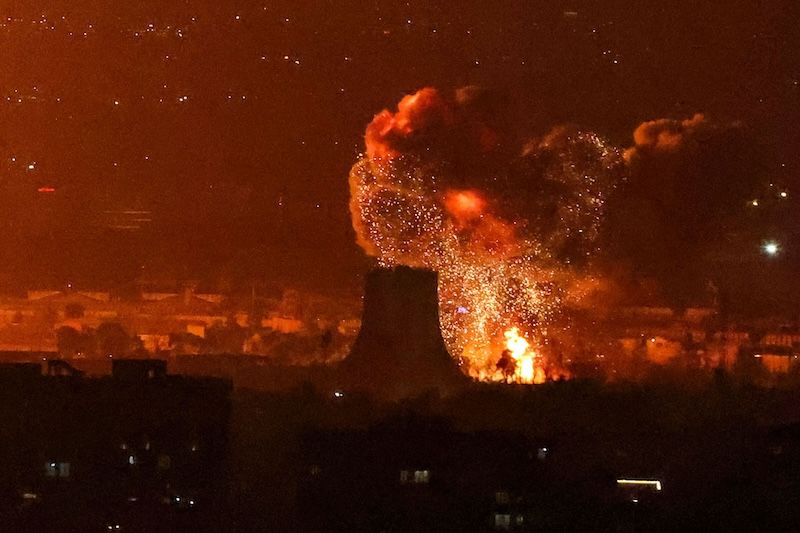
Explosions were reported across Tehran on Saturday as Israeli military officials confirmed that more than 80 fighter jets had conducted overnight strikes on infrastructure and military facilities. United States forces operating alongside Israel also continued a broader bombing campaign that military officials say has already hit thousands of targets.
Washington has framed the operation as an effort to dismantle Iran’s military capability and prevent future attacks on Israel and American interests in the region. Tehran rejects that justification and says the strikes represent an act of aggression against its sovereignty.
The result is a widening conflict with growing humanitarian and geopolitical consequences.
The US Israeli war on Iran has relied heavily on an extensive air campaign. US Central Command reports that more than 3,000 targets have been struck since the first attacks. Iranian officials say the damage extends beyond military infrastructure and has affected residential areas, hospitals, and schools.
Casualties have risen sharply. Iranian authorities estimate that at least 1,332 people have been killed since the bombing campaign began.
Among the most tragic incidents was the reported strike on a girls school during the first day of attacks. Iranian officials say more than 140 primary school students were killed in that incident. Another strike on a school later in the week reportedly killed at least 18 children and injured many others.
Independent verification of battlefield claims remains difficult, but humanitarian groups say the growing civilian toll highlights the scale of destruction inside the country.
Political rhetoric surrounding the US Israeli war on Iran has hardened as the conflict continues.
US President Donald Trump said the military campaign would not stop until Iran surrendered. Writing on the Truth Social platform, Trump stated that there would be no negotiations unless Tehran accepted unconditional surrender.
White House press secretary Karoline Leavitt later told reporters that the operation could last between four and six weeks. She said the objective was to dismantle Iran’s military infrastructure and neutralize its ability to threaten Israel or US interests.
Iranian President Masoud Pezeshkian rejected the demand and framed the war as a fight for national survival. In remarks posted online, he said Iran would defend its sovereignty and continue retaliatory strikes against military targets linked to the United States and Israel.
Pezeshkian said Iran was targeting military installations and bases rather than civilian populations in neighboring countries.
Retaliatory missile and drone attacks have widened the conflict far beyond Iran and Israel.
Iran launched strikes against military facilities linked to the United States across several Gulf countries, including Bahrain, Qatar, Kuwait, Saudi Arabia, and the United Arab Emirates.
Qatari authorities reported intercepting most of ten drones that approached their territory. Saudi air defense units also shot down several drones that were heading toward oil facilities near Riyadh.
Jordan said Iranian forces launched 119 missiles and drones toward installations within its borders during the first week of the conflict. Military officials there say most of the projectiles were intercepted.
Iran has acknowledged that some of its missiles struck countries hosting US military bases. President Pezeshkian issued a public apology to Gulf states and said Iran would avoid targeting neighboring countries unless attacks on Iran originated from their territory.
Despite that statement, retaliatory strikes continued across the region.
The conflict has also intensified along Israel’s northern border.
Israeli forces carried out an operation near the eastern Lebanese town of Nabi Chit, where heavy air raids resulted in dozens of casualties. Hezbollah said its fighters clashed with Israeli troops during the operation.
Israel stated that the raid aimed to locate information about Ron Arad, an Israeli pilot who disappeared during a mission over Lebanon in 1986.
Hezbollah responded with rocket attacks on northern Israel and issued warnings urging residents near the border to evacuate.
Lebanese authorities report that more than 200 people have been killed since the broader conflict began.
Israeli cities under repeated missile alerts
Inside Israel, air raid sirens have sounded repeatedly as Iranian missiles targeted major cities including Tel Aviv and Beersheba.
Israel’s air defense systems intercepted many incoming projectiles, but some missiles reached populated areas and explosions were reported during several waves of attacks.
Israeli authorities have imposed strict restrictions on the publication of images or video showing damage from Iranian strikes.
The US Israeli war on Iran has also created sharp diplomatic divisions internationally.
Russian President Vladimir Putin spoke by phone with Iranian President Masoud Pezeshkian and called for a diplomatic solution while offering condolences for those killed in the attacks.
The Kremlin has condemned the military campaign and warned that escalation could destabilize the wider region.
US officials say they are reviewing intelligence reports suggesting Russia may be sharing information about American military positions with Iran, although Washington has not confirmed those claims publicly.
European governments are also increasing their military presence in the region to protect shipping routes and support allies.
Britain has pledged fighter jets, helicopters, and a naval destroyer that could assist Saudi Arabia if necessary.
Spain has taken a different position and refused to allow US bases on its territory to be used for attacks on Iran. Madrid has also openly criticized the war.
Humanitarian agencies warn that the US Israeli war on Iran is rapidly becoming a regional crisis.
The United Nations estimates that at least 330,000 people across the Middle East have already been displaced by the fighting.
Air travel in the Gulf region has also been disrupted. Dubai International Airport temporarily suspended operations after explosions were reported nearby before limited service resumed later.
Protests against the war have emerged in several countries. In London, thousands of demonstrators marched through central streets calling for an immediate end to the bombing campaign.
Military analysts say the scale of the operation already carries enormous financial and strategic costs.
Research from the Center for Strategic and International Studies estimates that the first 100 hours of the campaign cost roughly $3.7 billion. Analysts estimate the conflict is costing US taxpayers about $860 million per day.
The United States has officially acknowledged six casualties among its forces. Iranian, Russian, and Chinese sources claim the number is far higher and say at least 560 American troops have been killed and many more injured, though those figures remain disputed.
The deeper concern among analysts is that the US Israeli war on Iran may evolve into a prolonged regional conflict with unpredictable consequences. The Middle East has experienced many cycles of escalation before, but the current confrontation involves multiple states, vast military resources, and a level of rhetoric that leaves little room for compromise.
For now, the war continues to widen, and the possibility of a diplomatic off ramp appears increasingly distant.