FIFA president Gianni Infantino has called for footballers who cover their mouths during on-pitch confrontations to face automatic sending-off, highlighting the growing scrutiny over conduct and accountability in professional football.

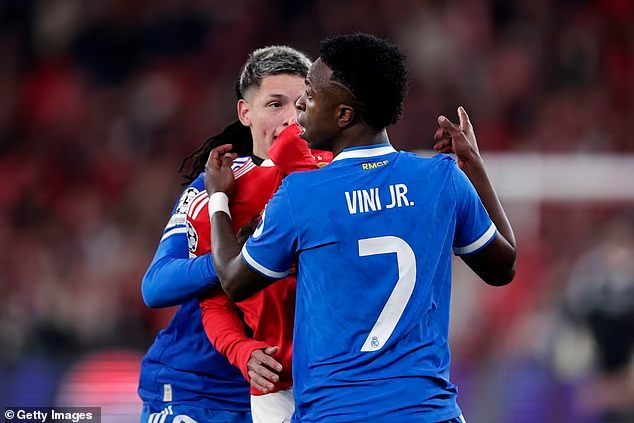
Infantino’s remarks follow a Champions League playoff incident involving Real Madrid forward Vinícius Júnior, who alleged that Benfica’s Gianluca Prestianni directed racial abuse at him during the first leg. Prestianni appeared to cover his mouth while speaking to Vinícius Júnior, an action that has sparked debate about transparency and discipline in football.
UEFA has launched an investigation into the allegation. Prestianni has been suspended for the second leg and faces a potential ten-match ban if found guilty by European football’s governing body.
“If a player covers his mouth and says something, and this has a racist consequence, then he has to be sent off, obviously,” Infantino told Sky News. “There must be a presumption that he has said something he should not have said. He would not have had to cover his mouth otherwise.”
Infantino acknowledged the challenge of addressing incidents that fall outside current rules. “Of course, when you deal with a disciplinary case, you have to analyse the situation, you have to have evidence, but we cannot just be satisfied with that going forward,” he said.
FIFA is now exploring measures to limit or prevent players from concealing their mouths during confrontations. The proposal was discussed at Saturday’s meeting of the International Football Association Board, with implementation potentially ahead of the 2026 World Cup.
“You can see when a player is talking to an opponent, there are very few circumstances where they should need to cover their mouth,” said Mark Bullingham, CEO of the English FA and IFAB member. These discussions are expected to progress at FIFA Congress in Vancouver next month, which may determine whether such measures are applied during international competition.
Infantino also suggested that the football community should encourage accountability and cultural change, not just impose sanctions. “Maybe we should think about not just punishing, but also allowing players or whoever does something to apologise,” he said. “You can do things that you do not want to do in a moment of anger and apologise, and then the sanction has to be different. We can move one step further, and maybe we should think about something like that as well.”
He added that such steps are essential to demonstrate seriousness in the fight against racism. “These are actions that we can take, and we have to take in order to be serious about our fight against racism,” Infantino said.
The incident has intensified debate over the ethics of concealed communication in football. Players, coaches, and governing bodies are now considering stricter disciplinary frameworks that balance accountability with opportunities for acknowledgment and reconciliation. The outcome could redefine how conduct is monitored on the pitch and shape FIFA’s broader anti-racism agenda in the years leading to 2026.